
You’re stepping onto the disc golf course, regular frisbee in hand, but is it really up to par? In this deep dive, you’ll uncover the nuanced differences between casual frisbees and professional golf discs.
We’ll dissect rules, etiquette, and performance, providing you with expert insights. You’ll learn the pros and cons, ensuring your choice maximizes your game.
Get ready to challenge your assumptions and elevate your disc golf experience with this comprehensive guide.
Grasping Disc Golf Fundamentals
Before exploring the nuances of using standard Frisbees for disc golf, it’s essential that you grasp the fundamental rules and objectives of the game itself.
Disc golf, akin to traditional golf, consists of completing a course in the fewest throws possible. Your arsenal includes various discs, each engineered with specific disc materials that affect aerodynamics and performance.
Mastery over an array of throwing techniques is crucial; from the power grip for distance to the delicate touch of a putt, each throw demands precision.
Analyzing disc materials reveals that standard Frisbees typically lack the specialized design of disc golf discs, potentially influencing flight paths and stability.
As you weigh the use of regular Frisbees, consider how their material composition could challenge your technical proficiency.
Regular Frisbees Vs. Golf Discs
As you delve into the world of disc golf, you’ll quickly notice that regular Frisbees and golf discs offer distinct flight characteristics imperative to your game strategy.
The material comparison is critical: golf discs are typically made from more durable plastics that can withstand frequent impacts with trees and the ground. This resilience affects the disc’s longevity and stability during flight.
Design significance also comes into play. Golf discs are engineered with a more aerodynamic profile, contributing to their ability to cut through the air for longer distances and with more precision.
Regular Frisbees, with their larger diameters and more rounded edges, are designed for casual play and offer a slower, more controllable flight ideal for catch but less suited for the varied demands of disc golf courses.

Best choice for: New Players, Long Anhyzers and Roller shots

EFFORTLESS GLIDE & PRECISION: Designed for maximum glide and smooth flight, the River is the perfect beginner fairway driver, or and for many will be their farthest flying disc. Whether you're a beginner or an advanced player, the River's unique blend of stability and control allows for so many different shots.

Mid-range golf driver
The Rules of Disc Golf
While you may be tempted to use a regular Frisbee due to familiarity, it’s essential to understand that disc golf has its own set of rules which dictate the types of discs permissible for play.
Disc selection is not merely a matter of preference; it follows specific guidelines that ensure fairness and consistency within the sport. The scoring system, akin to traditional golf, is intricate and relies on players understanding how each throw counts towards their final score.
| Aspect | Regular Frisbee | Disc Golf Specific Disc |
|---|---|---|
| Aerodynamics | Less Stable | Highly Engineered |
| Weight Distribution | Even | Varied by Design |
| Rule Compliance | Not always suitable | Mandatory |
Etiquette on the Course
When you’re on the course, minimizing noise is crucial as it can distract players and disrupt concentration, potentially affecting the outcomes of throws.
You must also respect playing order; it’s not only courteous but ensures a smooth flow of play and reduces the risk of interference.
Lastly, preventing littering preserves the course’s integrity and environment, which is fundamental for the sport’s sustainability and player experience.
Noise Minimization
Respect for fellow players mandates you minimize noise, ensuring everyone’s focus remains undisturbed on the course. Sound pollution not only disrupts concentration but also detracts from the serenity of the game’s natural surroundings. To facilitate stealth throws, one must consider the disc’s material and design, which can influence the level of noise generated upon impact with trees or chains.
| Aspect | Consideration | Benefit |
|---|---|---|
| Material of Frisbee | Softer plastics absorb impact, reducing noise | Less distraction for players |
| Design of Disc | Aerodynamic edges minimize flutter and associated noise | Enhanced focus during throws |
| Player Conduct | Subdued communication, gentle handling of gear | Maintains quiet ambiance on course |
Playing Order Respect
You’ll maintain the game’s flow and show courtesy to fellow players by adhering to the established playing order on the disc golf course. Understanding this hierarchy is crucial, as it’s typically determined by the scores of the preceding hole, allowing for a systematic progression.
The player with the lowest score throws first, creating a strategic framework that respects individual performance and skill in throwing techniques. Moreover, diligent score tracking is essential, as it dictates subsequent playing order and ensures fairness.
This analytical approach to the game also minimizes downtime between throws, optimizing the experience for all participants. Remember, precision in both your throws and scorekeeping underpins the integrity of play, reinforcing the respect for playing order that’s fundamental to the spirit of disc golf.
Littering Prevention
As you transition from understanding playing order to respecting the course, remember that preventing littering is a key aspect of disc golf etiquette. It’s not just about personal responsibility; it’s about integrating waste management strategies into your game.
Courses often have recycling initiatives in place—make use of them. Discard your trash in designated receptacles, separating recyclables accordingly. If a bin isn’t immediately available, hold onto your waste until you encounter one.
This disciplined approach ensures that courses remain pristine, reducing the environmental impact and preserving the natural beauty for fellow enthusiasts. Your adherence to these protocols reflects a technical understanding of the sport’s sustainability challenges and contributes to a culture of respect and care for the game’s venues.
Examining Flight and Distance Capabilities
As you assess the performance differences between regular Frisbees and disc golf discs, you’ll notice significant variations in flight stability.
Regular Frisbees typically exhibit less predictability in their trajectory, whereas disc golf discs are engineered for precise control and stable flight.
Moreover, when comparing distance capabilities, disc golf discs surpass regular Frisbees, offering you a clear advantage in achieving longer throws.
Flight Stability Variations
Every regular Frisbee exhibits unique flight stability characteristics that can significantly affect your disc golf performance. Analyzing the aerodynamic properties reveals how variations in shape and design contribute to flight behavior.
Regular Frisbees typically feature a broader rim and less dense material than specialized disc golf discs. This affects lift and drag coefficients, leading to less predictable flight paths, especially in windy conditions.
Material flexibility also plays a crucial role. A more flexible Frisbee can absorb energy upon release, altering speed and angle, which can destabilize its flight. In contrast, disc golf discs are generally stiffer, enhancing their stability.
You’ll find that a regular Frisbee’s performance fluctuates more, making precise control a greater challenge on the course.
Distance Capability Contrast
You’ll notice that a regular Frisbee can’t match the distance capacity of a specialized disc golf disc due to its design and material differences.
Analyzing their performance, the specialized disc typically has a more aerodynamic shape, reducing wind resistance and maximizing distance. In contrast, a regular Frisbee is designed for casual play and possesses a less streamlined profile, which significantly increases wind resistance and diminishes its range.
| Feature | Regular Frisbee | Disc Golf Disc |
|---|---|---|
| Aerodynamics | Less optimized | Highly optimized |
| Material Density | Lower | Higher |
| Wind Resistance | High | Low |
| Grip Differences | Less tactile | More pronounced |
| Distance Capacity (Average) | Shorter range | Longer range |
Grip differences also play a critical role; the contour and texture of disc golf discs are intended to provide a secure grip, allowing for a more powerful release, directly correlating to increased distance capability.
Pros of Casual Frisbees
Before diving into the technicalities of disc golf, it’s worth noting that using a regular Frisbee can offer a more relaxed and accessible introduction to the sport.
The affordability factor of casual Frisbees is a significant advantage. They’re typically less expensive than specialized disc golf discs, making them an economical choice for beginners. This cost-effectiveness is crucial for those who aren’t yet fully invested in the sport and are hesitant to make a substantial financial commitment.
Additionally, the grip texture of a standard Frisbee often provides a comfortable hold for newcomers. It’s less intimidating and more familiar to those who’ve enjoyed Frisbees recreationally. This familiar tactile feedback can enhance initial throwing experiences, fostering a positive first step into the realm of disc golf.
Is There a Difference in the Technique Used for Throwing Frisbees vs. Golf Discs?
When it comes to master elite frisbee throws, there is a distinct difference in the technique used for throwing frisbees vs. golf discs. The grip, release, and angle of the throw all vary between the two, with golf discs generally requiring a more controlled and precise release compared to frisbees.
Cons and Limitations Discussed
While some Frisbees may seem suitable for casual play, they often lack the design characteristics necessary for the precision and control required in disc golf.
You’ll find that their inappropriate weight distribution can lead to erratic flight patterns, which is detrimental when you’re aiming for consistency on the course. Regular Frisbees are typically lighter, causing them to be more susceptible to wind interference and less reliable for targeted throws.
Moreover, durability concerns arise with non-disc golf Frisbees. They aren’t built to withstand the repeated impacts against chains and baskets, nor the abrasive terrain of a rugged course. This leads to a shorter lifespan and compromised performance over time.
As a result, investing in proper disc golf equipment becomes not only a technical necessity but also a cost-effective choice in the long run.
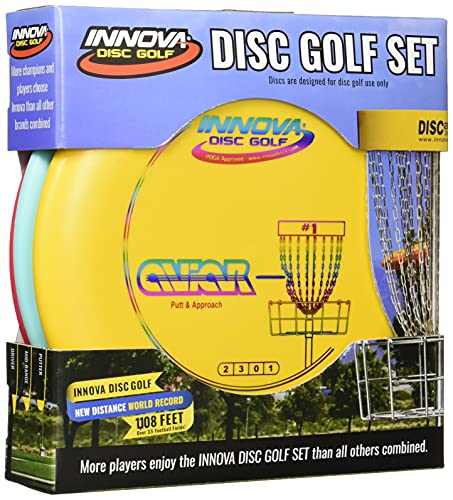
Complete Set: Includes One Driver, One Mid-Range And One Putter

PDGA Approved: This PDGA Approved U.S. Landmark disc set is 150 Class (145-150g) and includes 2 Putter (U.S. Capitol), 2 Mid-range (Statue of Liberty), 2 Driver (Golden Gate Bridge), and 1 Mini Maker

COMPLETE SET: This complete disc golf set from Franklin Sports is the perfect yard game for a family picnic, barbecue, or other get-together