
In the world of disc golf, mastering the front hand throw is akin to discovering the holy grail of precision and distance. You’ve likely spent countless hours pondering the secret behind that perfect, smooth arc that seems to cut through the air as if guided by unseen forces.
Understanding the grip is the cornerstone; it’s where the journey begins but hardly where it ends. As you adjust your stance and posture, remember the subtleties that can turn a mere toss into a flight worthy of envy.
The X-Step technique isn’t just a dance move—it’s a critical component that coordinates your body’s momentum. And when it comes to arm speed and angle, precision is your ally.
But just as you’re about to release that disc, you realize there’s an art to the follow-through, one that could either make or break your game. As you’re contemplating the myriad ways your throw can improve, consider the common pitfalls that even seasoned players encounter.
If you’re keen to elevate your game and avoid those mistakes, stay tuned for insights that could transform your casual toss into a formidable weapon on the course.
Grip Fundamentals: The Cornerstone
Mastering your grip is crucial, as it directly influences the disc’s stability, speed, and flight path during a front hand throw.
Firstly, position your thumb on the top of the disc for control; it should feel secure without straining your muscles. Your index finger is pivotal, either rimming the edge or tucked underneath, depending on personal comfort and throw precision.
Middle, ring, and pinky fingers should press against the inner rim, providing the necessary force for a spin. Ensure a firm yet flexible hold—too tight and you’ll stifle the spin, too loose and you’ll sacrifice accuracy.
This grip, once refined through practice, grants you the autonomy to navigate any course, crafting shots that defy obstacles and maximize your disc’s inherent potential.
Footwork for Power: Stance and Pivots
Align your feet shoulder-width apart, ensuring your lead foot points towards the target, creating a stable base for your throw.
Keep your spine straight and shoulders squared, optimizing the transfer of energy from your lower body through the kinetic chain.
You’ll maintain balance and control throughout the motion, essential for precise disc release.

CORRECTS HAND POSITIONING ON EVERY SWING: Molded guide attaches to your club and places your fingers, thumbs, and palms in the correct neutral grip position; helps eliminate common faults like a strong grip, weak grip, or open right hand that lead to slicing and hooking
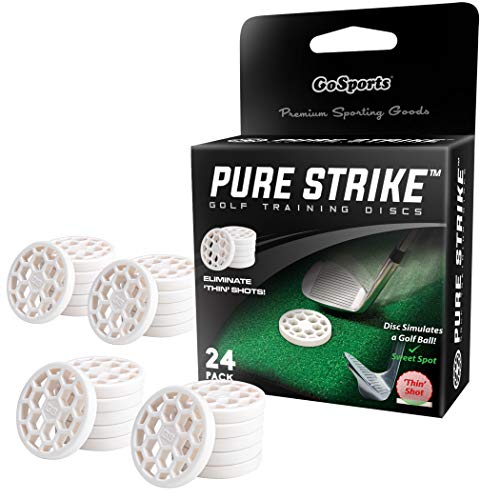
IMPROVE BALL CONTACT: Pure Strike Golf Training Discs help golfers practice cleaner ball-first contact and more consistent strikes while improving swing path, low point control and compression

Right-handed golf swing training.
Proper Foot Positioning
To achieve a powerful and accurate front hand throw in disc golf, you must first establish a stable stance. Ensure your feet are shoulder-width apart and parallel to the target line. Your lead foot, typically your left if you’re right-handed, should be slightly ahead of the trailing foot to allow for optimal weight transfer during the throw.
As you progress through the motion, pivot on the heel of your lead foot. This will align your hips and shoulders with the trajectory of the disc.
The trailing foot’s role is pivotal for maintaining balance and generating torque. Keep it anchored and ready to rotate.
Optimal Body Alignment
Building on the foundation of proper foot positioning, optimal body alignment further refines your stance and posture to enhance both the power and accuracy of your front hand throw in disc golf.
You’ll want your hips and shoulders to align with the trajectory of your intended throw. This alignment ensures that your energy transfers efficiently from your lower body through the disc.
Engage your core to maintain stability, and keep your back straight to prevent injury and promote a fluid motion. Your head should be up, eyes fixated on your target, allowing for precise focus.
The X-Step Technique
Mastering the X-Step technique is crucial for adding power and stability to your disc golf drives. This dynamic footwork pattern optimizes your body’s torque and momentum, transforming your energy into maximum distance on the fairway.
Embrace the freedom of movement it offers, and watch your game soar.
- Start with your feet shoulder-width apart:
- Lead with a short step forward using your left foot (for right-handed players).
- As you step, rotate your hips and shoulders back, priming your body.
- Integrate the cross-step:
- Bring your right foot behind your left, creating an ‘X’ with your legs.
- This motion should be fluid, harnessing the power coiled in your torso.
Arm Speed and Angle
Achieving optimal arm speed and release angle is essential for executing precise and powerful disc golf drives.
To maximize your arm’s velocity, focus on a fluid motion that starts from the ground up, channeling energy from your legs through your core and into your arm. It’s not merely about raw strength; it’s about the timing and efficiency of your kinetic chain.
For your release angle, understand the disc’s aerodynamics. A hyzer angle—where the disc’s edge is tilted downward—will produce a leftward curve for right-handers, while an anhyzer angle does the opposite.
Adjusting the nose angle relative to the horizon also affects lift and distance. You’ll need to experiment with various release angles to master different shots and wind conditions, always aiming for consistency in your execution.
Mastering Release and Follow-Through
Having fine-tuned your arm speed and release angle, it’s crucial to nail the release and follow-through for a consistent and controlled disc golf throw.
The release should be fluid, allowing the disc to exit your grip naturally at the correct point. Your follow-through maintains the disc’s flight path, stabilizing its motion through inertia.
- Release Mechanics:
- Snap your wrist confidently, don’t hesitate.
- Let the disc roll out of your fingers, minimizing off-axis torque.
- Follow-Through Dynamics:
- Continue your arm’s motion in the direction of the throw.
- Rotate your shoulders fully to alleviate stress and avoid injury.
Practice Drills
To refine your front hand throw in disc golf, incorporate targeted practice drills that simulate game conditions and focus on form refinement. Start with field work, repeating drives to build muscle memory.
You’ll want to practice various angles, honing hyzer and anhyzer releases with consistency. Set up mock fairways using trees or poles as obstacles to navigate your disc’s flight path, working on both power and precision.
Engage in putting drills, too, starting close to the basket and gradually increasing distance as you gain confidence. Remember, it’s not just about sheer distance; accuracy is paramount.
Allocate time for upshots, practicing controlled approaches that land within the circle. These drills aren’t just exercises—they’re your ticket to unrestrained performance on the course.
Keep it focused, maintain a growth mindset, and your skills will soar.
How Can I Improve My Disc Golf Technique Without Causing Shoulder Pain?
To improve your disc golf technique without causing shoulder pain, consider several solutions for throwing pain. Focus on proper warm-up and stretching before playing, strengthen your shoulder muscles with specific exercises, and practice proper throwing techniques to reduce strain on your shoulder. Additionally, using the right disc and adjusting your throwing form can also help alleviate shoulder pain.
Common Mistakes to Avoid
As you refine your disc golf front hand throw, it’s crucial to address common grip technique errors that can undermine your control and distance.
Ensure your stance and posture are optimized for stability and power, avoiding the tendency to hunch or over-rotate.
These foundational aspects set the stage for consistent, accurate throws and contribute significantly to your overall performance.

Ultimate Comfort for the Course & Beyond - Crafted from high-quality, breathable cotton, these crew socks provide all-day comfort whether you're on the disc golf course or relaxing at home. They offer excellent cushioning and moisture-wicking to keep your feet dry and comfortable during long games or daily wear.

DISC GOLF SOCKS FOR MEN: Crafted with a beautiful design and premium materials, these socks combine style and comfort - a practical gift any disc golf enthusiast will enjoy year-round. Ideal for disc golf accessories, disc golf accessories for men, disk golf accessories, frisbee golf accessories, disc golf socks for men, frisbee socks, disk golf socks, disc golf socks for men funny

QUALITY:We use 80% Cotton, 17% polyester, 3% Elastane to ensure our socks soft, comfortable, stretchy and breathable. No fading, hold up well in the laundry.
Grip Technique Errors
Mastering the proper grip is crucial in disc golf, yet many players inadvertently sabotage their throws with common grip mistakes. You’ve got to ensure your hold isn’t just comfortable but technically sound to optimize your throw’s power and accuracy.
Watch out for these errors:
- Overly tight grip
- Causes unnecessary tension
- Reduces wrist snap efficiency
- Too loose a hold
- Disc may wobble upon release
- Leads to inconsistent throws
Ensure your fingers apply balanced pressure and your thumb positions correctly atop the disc. Don’t let a suboptimal grip undermine your freedom to make the disc soar.
Study your hand position, practice deliberately, and soon, you’ll be releasing with confidence and precision, leaving these common grip errors behind.
Improper Stance and Posture
Having addressed the grip, it’s equally essential to consider how your stance and posture can make or break the effectiveness of your disc golf front hand throw.
An incorrect stance limits your throw’s power and accuracy. Ensure your lead foot points towards the target; this facilitates a full hip rotation and generates maximum power. Your rear foot should be perpendicular to the target line, providing stability and balance.
Avoid rounding your back; instead, maintain a straight spine to optimize the reach-back and follow-through. Your shoulders should be level, and your head must remain up, eyes on the target.