
In the realm of disc golf, the power of a crushing drive contrasts with the finesse of a well-placed approach, and it all starts in your hands. You’ve got the freedom to craft your game, and mastering various forehand grips is key to unlocking your full potential on the course.
Whether you favor the control of a two-finger stack or the distance a power grip affords, it’s up to you to find the hold that best suits your style. Tinkering with different grips, you’ll discover how subtle shifts can dramatically alter your disc’s flight.
Remember, there’s no one-size-fits-all solution here; you’re free to experiment and embrace the grip that feels like an extension of your own strategic play. So grip it your way, and let that disc fly true to your unique form.
Getting Started: Grip Fundamentals
You’ll typically begin mastering the forehand grip in disc golf by learning how to position your fingers and thumb effectively around the rim of the disc.
To grip the disc, place your index and middle fingers around the rim, with a focus on firmness and control rather than excessive force. The thumb should rest atop the disc, providing stability without hindering the spin. Precision in the forehand grip aligns your throwing arm for a cleaner release.
Avoid rolling your wrist, as this can disrupt the disc’s intended flight path. Instead, use a snap from your forearm and wrist, maintaining a consistent angle throughout the throw. This technical nuance ensures the grip complements your throwing style, enhancing both power and accuracy.
Standard Forehand Grip
Building on the basics of the forehand grip, you’ll find that the standard grip is designed to optimize both control and power in your throws.
As you perfect your technique, this grip allows for a consistent release of the disc. It’s essential to ensure that your fingers are positioned correctly against the rim of the disc.
Here’s an analytical breakdown in a table format:
| Aspect | Detail | Importance |
|---|---|---|
| Thumb Placement | On top of the disc | Stabilizes flight |
| Index Finger | Under the rim, against the flight plate | Assists in a controlled release |
| Middle Finger | Along the inside rim | Adds power to the throw |
| Wrist Movement | Snappy and controlled | Dictates spin and speed |
| Disc Orientation | Slightly angled up | Ensures proper aerodynamics |
As a forehand thrower, the standard forehand grip is your fundamental tool. Mastering it grants you the freedom to adapt swiftly to various discs and scenarios.

Training grip provides the correct hand position for the right golf grip
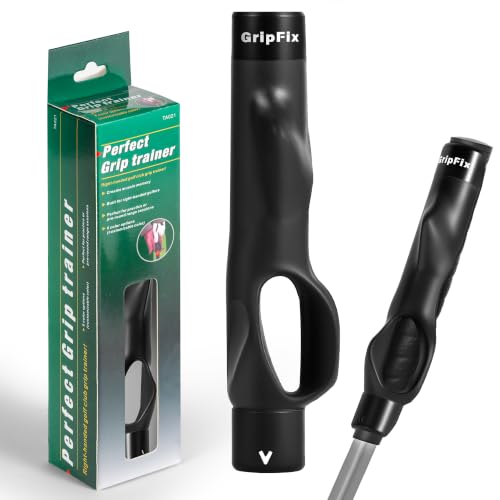
STOP SLICING & HOOKING INSTANTLY — Most inconsistent shots start with a bad grip. GripFix's precision-molded guides lock your left and right hands into the correct neutral position on every swing. Build muscle memory that eliminates weak grips, overlapping fingers, and palm misalignment — the fastest way to straighten your drives and gain shot confidence without expensive lessons.

🥏 Disc Golf Pocket Guide is in the size of classic card (2.36 x 3.54 inches). So it's really compact and you can easily carry it with you, store it in your pocket, bag or wallet.
Maximizing Power: The Power Grip
In mastering the power forehand grip for disc golf, you’re seeking to maximize your throwing force without sacrificing control.
The placement of the disc in the palm of your hand is fundamental. Ensure it sits comfortably yet firmly, allowing your fingers to wrap around the disc’s edge.
Your finger grip, specifically the index and middle fingers, should press along the rim. This positioning provides leverage and stability as you unleash the disc.
Opt for a tighter grip with your thumb pressing down on the disc’s top. This pressure counteracts the fingers’ force, ensuring a stable and powerful release.
Analyze each throw’s outcome to refine your technique, adjusting the grip as necessary to suit your style and the disc’s flight characteristics.
Fan Grip Technique
As you refine your fan grip technique, it’s crucial to assess the interplay between grip strength control and the resulting impact on accuracy and distance.
You’ll need to experiment with finger placement variations to find the optimal arrangement that complements your playing style and the specific disc you’re using.
Keep in mind that subtle adjustments to your grip can significantly influence the stability and trajectory of your shots.
Nuanced Control: Grip Strength Variations
Your mastery of grip strength when employing the fan grip technique can significantly enhance the precision of your shots in disc golf. Gripping the disc with a fan grip involves spreading your fingers beneath the flight plate, allowing for nuanced control.
The fan grip is especially versatile; you can modify it to adapt to different grips required by various discs and shot demands. A lighter grip strength can yield greater distance but may sacrifice stability, while a firmer grip ensures control but might reduce range.
The modified fan grip, where you tuck one or more fingers closer to the rim, offers a compromise between power and finesse. Consistently practicing grip strength control with the fan grip will ultimately lead to more accurate and controlled throws.
Accuracy Vs. Distance
You’ll find that the fan grip in disc golf offers a trade-off between accuracy and distance, with your choice depending on the specific challenges of each hole.
This grip enhances your control, enabling you to navigate tight fairways and capitalize on wind conditions, where precision trumps maximum distance.
Forehand grips, like the fan grip, distribute your fingers evenly under the disc, with the thumb positioned on top to stabilize the flight.
Finger Placement Variation
In the fan grip technique, adjusting your fingers’ positions can significantly impact the disc’s flight and your throwing comfort. For forehand grips in disc golf, finger placement variation is key.
Here’s a breakdown of how to position each finger using the fan grip technique:
| Finger | Position on Disc | Effect on Throw |
|---|---|---|
| Pointer Finger | Along the rim’s edge | Adds stability, precision |
| Middle Finger | Spread out or tucked in | Controls power, spin |
| Remaining Fingers | Lightly against the underside | Balances grip, minimizes flutter |
While the backhand power grip relies on a firm wrap of fingers, the forehand fan grip values subtlety. Experiment to find the sweet spot where your pointer finger and middle finger provide the perfect blend of power and control, giving you the freedom to shape your shots as desired.
Compensating Flight: Adjusting Grips
When adjusting your grip for stability, you’ll need to consider the inherent stability of the disc itself. Altering your grip can compensate for a disc’s natural flight pattern, enabling you to maintain control in various throwing conditions.
It’s essential to analyze the relationship between your grip tightness and the disc’s behavior to master consistent forehand throws.
Grip Vs. Disc Stability
Adjust your grip to modulate the disc’s stability, ensuring a consistent release tailored to your desired shot.
When selecting from the grips used by seasoned players, consider the common grip that places the ring finger along the underside of the disc. This position offers a balance between control and power, vital for managing the disc’s stability.
For more fines shots, a grip utilizing just two fingers may provide the precision needed. The stability of your disc is directly influenced by the pressure exerted by these fingers. Too firm, and the disc may veer unexpectedly; too light, and you’ll lose control.
Master the nuanced application of pressure to fine-tune the disc’s flight, and you’ll unlock the freedom to shape your throws as desired.
Experimenting with Grips: Altering Flight
You’ll notice that a subtle change in your grip can significantly alter your disc’s flight pattern, enhancing or reducing its stability mid-air. As disc golfers, you’re constantly seeking that perfect throw, and altering flight patterns is a technical skill that can set you apart.
When adjusting forehand grips, consider the orientation of your palm. This affects the wrist motion, which is crucial in tailoring the disc’s flight.
For lighter discs, a grip with less spin may suffice, while more stable discs might demand a firmer grip to maintain their intended path. Experiment with different grips to find one that feels natural and complements your arm’s motion.
This fine-tuning allows you to manipulate the discs flight, giving you the freedom to master various courses and conditions.
Advancing Your Game: Targeted Grip Drills
While refining your forehand grip for disc golf, it’s essential you incorporate specific drills that target grip strength and precision to elevate your game.
To keep your palm stable and enhance your throw, perform resistance exercises with hand expanders or stress balls. Mimic the forehand motion, focusing on maintaining pressure throughout the throw to replicate in-game conditions.
Pay attention to top pros; observe how they’re able to throw with both power and control. Emulate their techniques in your drills, ensuring you’re not just gripping the disc, but also engaging your entire forearm.
These targeted practices will help you develop the nuanced strength required to compete at the next level. Consistency in these drills is key to upgrading your forehand grip’s effectiveness.
What Are the Best Forehand Grip Techniques for Disc Golf to Avoid Throwing Errors?
When it comes to improving your disc golf game, mastering the forehand grip is essential for avoiding disc golf throwing errors fix. The power grip and the fan grip are two popular techniques that can help you achieve greater accuracy and distance with your throws. Experiment with both to see which works best for you.
Conclusion
In conclusion, your choice of forehand grip in disc golf is crucial for precision and power. Whether you opt for the control of a fan grip or the force of a power grip, practice is key.
Experiment with different styles, adjusting for disc stability to optimize your shots. Incorporate grip drills into your routine to refine your technique.
Remember, the right grip enhances your game, so analyze your needs and adapt your hold accordingly. Embrace the change for a sharper forehand.

ABOUT THE HARPOON - The Harpoon is a really shallow approach disc. It is extremely consistent, versatile, and reliable for overstable shots. Whatever task is at hand, the Harpoon can handle it

ABOUT THE TRESPASS – The Trespass is a high-speed distance driver built for players who want to push their drives further without sacrificing control. Its wide rim design handles maximum power, making it a go-to option for distance shots across all skill levels—from beginners testing out their first distance driver to advanced players seeking accuracy with big distance. Perfect for players building their collection of disc golf drivers, this disc delivers reliable performance.

ABOUT THE CURL - This distance driver is an essential gap in the bag between max-distance drivers and fairway drivers, and the Curl fills this perfectly. A comfortable 11-Speed rim with a good amount of understability means you