
You’ve tossed a frisbee, felt the rush of the throw, and maybe even sunk a few into makeshift baskets. But have you ever wondered how your casual backyard game evolved into a championship sport?
Dive into the rich narrative of frisbee golf’s ascent from humble origins to global phenomenon. You’ll explore the pivotal moments, technological leaps, and the free-spirited community that’s shaped the disc’s captivating flight from past to present.
Prepare to be enthralled by disc golf’s storied journey.
The Origins of Frisbee as a Backyard Amusement
Your journey into the history of frisbee golf must begin with the toy’s humble origins as a simple pie tin tossed for amusement in the early 20th century.
Initially, these metallic discs weren’t the aerial marvels you know today. In fact, the concept of flying saucers was still the stuff of pulp fiction.
However, this pastime, a whisper of freedom on the tips of college students’ fingers, spiraled into a cultural phenomenon.
It’s critical to recognize that the transition from pie tin to the Wham-O invention – the first official Frisbee – was pivotal. Introduced in the late 1950s, Wham-O capitalized on the post-war era’s fascination with UFOs, crafting a narrative of leisure that echoed society’s yearning for unbounded recreation.
This invention set the stage for frisbee golf’s inception, propelling a backyard amusement into a sport of precision and passion.
The Birth of Disc Golf in the 1970s
As you examine the emergence of frisbee golf, you’ll find that the transformation of early flying discs into specialized equipment marks a pivotal shift.
With the establishment of the first courses in the 1970s, a structured space for competitive play was set, sparking the sport’s steady climb in popularity.
This burgeoning interest laid the groundwork for a community that would soon witness frisbee golf’s evolution into a sport with global reach and professional stakes.

PDGA Approved: This PDGA Approved U.S. Landmark disc set is 150 Class (145-150g) and includes 2 Putter (U.S. Capitol), 2 Mid-range (Statue of Liberty), 2 Driver (Golden Gate Bridge), and 1 Mini Maker
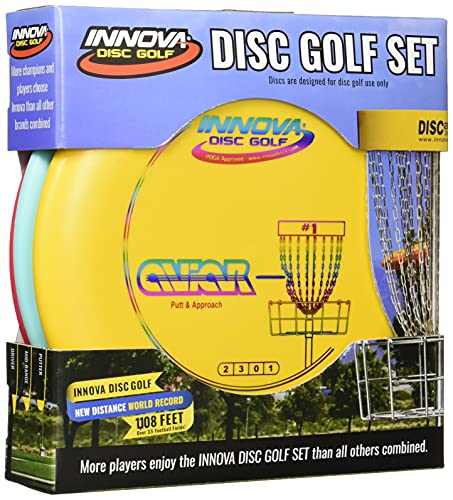
Complete Set: Includes One Driver, One Mid-Range And One Putter

ALL YOU NEED TO START - This disc golf beginner set contains 3 of our most popular from our entire lineup and provides you with a putter, midrange & a fairway driver. Everything you need to head out to the course. Our disc golf disc set includes some of the most widely known best disc golf discs for beginners just starting out, in an easy to throw plastic
Early Flying Discs
Although you may associate flying discs with casual park games, it’s during the 1960s that frisbee golf began to take shape, transforming these playful discs into the focus of a competitive sport.
The evolution of disc material played a crucial role; from the metal lids of pie tins to the durable plastics of today, each iteration offered a new level of freedom and performance.
The spirit of ancient games, where objects were hurled for sport, found a modern echo in frisbee golf’s trajectory. Analyzing its ascent, you’ll find athletes and enthusiasts alike pushing the boundaries of what these discs can achieve.
This wasn’t just a pastime—it was a declaration of liberty, with each throw challenging the confines of traditional sports.
First Courses Established
You’ll witness the genesis of frisbee golf as enthusiasts began carving out the sport’s first dedicated courses in the early 1970s.
Beyond the backyard beginnings, the minds behind the course design sought open spaces that yearned for the flight of a disc, spaces where freedom was etched into the landscape itself.
They analyzed the terrain, envisioned fairways where none existed, and turned public parks into battlegrounds of skill and strategy. Each tree, each bend in the path, became a natural obstacle to challenge players’ precision and creativity.
The courses were a testament to the sport’s liberating ethos, giving players the room to explore the limits of their throws in environments crafted to respect both the heritage of the game and the call of the wild.
Sport’s Popularity Growth
While the earliest courses were taking root, you’d begun to witness frisbee golf’s surge in popularity, as it transitioned from a pastime to a sport with a burgeoning following. This wasn’t just about throwing discs; it was about the freedom to play, to engage with a community that thrived on open spaces and shared enthusiasm.
Urban courses became not just playgrounds but social hubs, where community engagement was as integral to the experience as the sport itself.
Every new course reflected a commitment to accessibility, inviting players from all walks of life to partake in the joy of the game. You saw a camaraderie emerge, one that was unfettered by the exclusivity that often shadows traditional sports.
In frisbee golf’s growth, you witnessed a celebration of freedom and inclusivity.
The 1970s and Disc Golf
As you explore the 1970s, you’ll find that disc golf’s roots were firmly taking hold. The first permanent courses materialized from the dreams of flying disc enthusiasts. It was a decade marked by the inception of organized play, giving rise to tournaments that would set the stage for the sport’s competitive future.
These foundational years were critical in shaping disc golf, culminating in key events that transformed casual backyard pastime into an emerging sport with its own legends and lore.
Origins of Disc Golf
The 1970s marked disc golf’s inception, with your backyard games evolving into a sport of precision and skill. Casual throws of flying saucers that once arced above clotheslines began to find a more ambitious trajectory. You sought freedom, not just from the confines of your lawn, but in the pursuit of a game unbound by the strictures of traditional sports.
As you and others refined your throws, the flying disc transformed from a mere toy into a competitive apparatus. Courses sprouted—no longer improvised, but designed with intention. The simple joy of watching a disc glide seamlessly through the air morphed into a passion for mastering flight paths and navigating obstacles.
This was the era when disc golf’s identity was forged, setting the foundation for the beloved sport it’s today.
Establishing Dedicated Courses and Tournaments
In the mid-1970s, you witnessed the birth of the first dedicated disc golf courses, appearing amidst public parks and on the outskirts of college campuses. Course design was in its infancy, with creators experimenting with varied terrains and obstacles to challenge players’ skills.
As you navigated these pioneering courses, disc technology was also evolving. Manufacturers began crafting discs specifically for the sport, enhancing your experience with improved precision and control.
These courses were more than mere playing fields; they symbolized a communal space where freedom and competition coexisted. Your throws weren’t just about distance but creativity, as each hole offered a unique puzzle crafted by the land itself, beckoning you to leave your mark on the nascent world of disc golf.
Key 70s Tournaments
Exploring the early disc golf courses, you soon found yourself amidst the competitive fervor of the 1970s key tournaments, where players came to test their mettle and shape the future of the sport. The decade’s contests weren’t merely casual throwabouts; they were battlegrounds for 70s icons, individuals who’d later be regarded as the pioneers of disc golf.
Analyzing the tournament formats, you’d notice a trend towards structured competition, a stark contrast to the sport’s informal roots.
As you delve deeper, you realize these tournaments were pivotal, setting standards and forging a path to professional play. The narrative of each contest tells a story of evolving strategies, the embracing of complex rules, and the freedom to transform open fields into arenas of flight.
Each throw encapsulated the ethos of liberty that the players of the era so deeply cherished.
The Formation of the PDGA and Rise of Disc Technology
You’ll find that someone’s vision for a more organized approach to frisbee golf materialized with the formation of the Professional Disc Golf Association (PDGA) in 1976.
The PDGA leadership, a dynamic ensemble of pioneers, recognized the potential of this burgeoning sport. They crafted a structure that would harness the anarchic energy of its players into a regulated yet liberating competitive framework.
As the PDGA’s influence grew, so did its membership demographics, evolving from a tight-knit community to a diverse array of athletes. The narrative of growth is etched in the expanding registry, marking milestones of inclusivity and breadth.
By analyzing the PDGA’s trajectory, you witness a microcosm of freedom’s allure, each member’s story intertwined with the association’s ascent from casual pastime to a legitimate sport with global recognition.
Technological Advancements
How have technological advancements shaped your experience of frisbee golf since the PDGA’s inception?
Material science has revolutionized the game, offering you discs forged from polymers that provide unprecedented grip, durability, and aerodynamics. These advances allow for a freedom of play previously unimagined, with discs tailored to your unique throwing style and the diverse conditions of courses.
Disc innovation hasn’t stopped at just the materials; it’s also about the meticulous design alterations. Engineers and athletes collaborate to tweak every aspect of a disc’s profile, ensuring that when you release it into the wind, it behaves with a predictability that was once the stuff of dreams.
Each throw is a narrative, a detailed story of physics, finesse, and freedom, all thanks to the relentless march of technology in frisbee golf.
Disc Golf’s Explosive Global Growth and Modern Influence
Harnessing these technological leaps in disc design, you’ve now witnessed frisbee golf’s explosive growth beyond its humble beginnings, establishing footholds in countries across the globe. This global expansion isn’t just a testament to the sport’s appeal; it’s a phenomenon fueled by the synergy of disc golf tourism and professional endorsements.
As you traverse the world, you encounter courses carved into the landscapes of Sweden’s serene forests, Finland’s vast lakesides, and Australia’s sun-bathed coasts. These destinations aren’t just stops; they’re strategic, drawing enthusiasts to the sport’s liberating embrace, free of confined arenas and rigid schedules.
Through the narratives of top-tier athletes and the allure of international tournaments, you’re experiencing a sport unchained, spreading its wings on a windswept journey around the planet.
How Has the Evolution of Frisbee Contributed to the History of Disc Golf?
Tracing the evolution of frisbee helps understand the history of disc golf. From its invention in the 1950s to the development of different disc designs, frisbee’s evolution has directly influenced the sport of disc golf. As frisbee technology has advanced, so has the skill and strategy involved in disc golf.
Modern Championships and Influence
Grasping the significance of modern championships, you’re now entering a realm where disc golf’s influence shapes not only the landscape of competitive sports but also the cultural fabric of communities worldwide.
Course design has become an art, with architects sculpting intricate fairways that challenge the elite while welcoming newcomers. These battlegrounds are where freedom of expression and strategic cunning coalesce, giving rise to thrilling spectatorship.
Player sponsorships have transcended mere branding; they’re fostering growth and nurturing talent, allowing athletes to pursue liberation from financial constraints.
As you dissect the fabric of these tournaments, you’ll find a narrative of resilience and innovation—a tale where once casual backyard tosses have catapulted into a global phenomenon, and where freedom to play, create, and excel is celebrated.

Note: Long press the ON button for 2-3 seconds to turn on the power saving mode. After installing 3 AAA batteries, the light will be on automatically, make sure the light is on before using the remote control

QUIET - Reduces noice from basket chains for a quieter practice

Proper Dimensions for Application: the disc golf basket stands about 29 inches/ 73 cm tall, with a top cover of about 10 inches/ 25.4 cm, a basket of about 11.7 inches/ 29.8 cm, a base of about 10.5 inches/26.8 cm, the mini discs of about 3.9 inches/9.8 cm, measured in diameter, suitable size for you to use