
As you chart your own course through life, much like a disc flying toward an unseen basket, you’re likely curious about the size of the community sharing your passion for disc golf.
You’re not alone on the fairway; there are hundreds of thousands of disc golfers out there, with the Professional Disc Golf Association (PDGA) boasting over 200,000 members. These figures are just the tip of the iceberg, as casual players abound.
In 2021, for example, at least 43,277 new enthusiasts joined the PDGA ranks, and millions of rounds were played worldwide. It’s a sport that values freedom, with open skies and varied landscapes, and its community is as diverse as the courses they play on.
So, as you grip your disc, know that you’re part of a growing global family, united by the love of the game.
Early Origins of Disc Golf
Before diving into the current state of disc golf, you’ll find its roots trace back to the early 1950s-60s when the game was first played with improvised targets. This nascent stage marked the early origins of disc golf, a pastime that has evolved significantly since.
As you explore its development, you’ll discover how informal matches laid the groundwork for the structured play we see today. The establishment of the Professional Disc Golf Association (PDGA) was pivotal, providing a framework for PDGA members and enthusiasts to enjoy and expand the sport.
Playing disc golf transitioned from a casual activity to an organized sport with standardized rules, reflecting a commitment to the game’s integrity and the liberty to innovate within its bounds.
Growth Through the Decades
Reflecting on the past decades, you’ve witnessed disc golf’s transition from a niche hobby to a mainstream sport, with its player base expanding exponentially. PDGA membership doubling from 100,000 to over 200,000 within four years exemplifies the surge in new members.
This marked increase in growth rates is further evidenced by the 4.3 disc golf courses installed daily in 2022. Analyzing play frequency, you’ll notice a significant jump: 51.6 million rounds were played in 2020, escalating to 205 million holes in the last two years.
The percentage of disc golfers globally is climbing, underscored by Finland’s 1,000th course milestone. These metrics indicate not just a growing interest, but a community embracing disc golf’s freedom and accessibility.
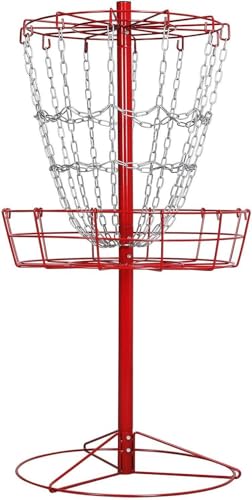
Stable & Robust: This solid basket contains 12 strands of heavy-duty chain for better catching; welded joints and big base frame strengthen the stability of this basket; comes with 3 ground stakes for double stability, no need to worry about tipping over by the hit from the disc or wind.

PROFESSIONAL 24-CHAIN CATCHING: Improve your putting accuracy with a professional 24-chain disc golf basket featuring inner and outer chains. The heavy-duty chain system helps reduce bounce-outs and creates a more realistic course-style practice experience for players of all skill levels

Solid Construction: This disc golf basket is crafted with a powder-coated metal frame and heavy-duty galvanized chains to handle any type of weather and won't let you down during your outdoor disc adventures.
Disc Golf Course Expansion
You’ve seen disc golf courses proliferate, with 9-hole courses now doubling the growth rate of their 18-hole counterparts. This course expansion reflects a strategic approach, catering to a demographic that values quick and flexible play.
The number of courses worldwide has surged, with an average of 4.3 courses installed daily in 2022, illustrating the sport’s escalating appeal. Disc Golf Pro events and local enthusiasm have spurred the growth, particularly in countries like Finland and Sweden, where access rates exceed 70%.
Moreover, educational institutions are increasingly incorporating courses, with a 20% uptick at schools and universities. This trend underscores disc golf’s integration into communities, promoting a sport that offers freedom and accessibility to enthusiasts across 81 nations.
Global Disc Golf Popularity
You’ll find the soaring popularity of disc golf reflected in the diverse player base that spans the globe, from casual players to professional athletes.
This global disc golf popularity is evident from the number of courses around the world, with countries like Estonia and Finland leading the charge in accessibility and growth. Disc golf clubs are forming globally, including in regions such as Latin America, where the sport is gaining traction.
Here’s a quick snapshot of disc golf’s worldwide presence:
| Country | Courses |
|---|---|
| United States | Most Worldwide |
| Finland | 1,000+ |
| Estonia | High Access |
| Norway | Growing |
| Latin America | Emerging |
Analyzing these figures, it’s clear that disc golf is not just a sport—it’s a movement embracing freedom and unity across countries and cultures.
Demographic Breakdown
As you examine the demographic breakdown of disc golfers, it’s evident that the sport spans a wide age range, with an average participant age of 33 years.
You’ll observe that the gender participation ratio is heavily skewed, with men comprising 85% of players, suggesting targeted efforts may be needed to balance gender representation.
Additionally, the predominance of white players at 91% highlights a significant racial homogeneity, pointing to potential barriers to entry for non-white individuals.
Age Range Analysis
Exploring the age range of disc golfers reveals a broad spectrum, with the average participant being 33 years old.
Your age range analysis would show that disc golf attracts active members from various life stages, reflecting the sport’s universal appeal. There’s been an influx of new, younger players, yet the game also retains those of old age, emphasizing its accessibility and lifelong playability.
Here’s a breakdown of the age distribution:
| Age Bracket | Percentage |
|---|---|
| Under 18 | 5% |
| 18-24 | 15% |
| 25-34 | 35% |
| 35-44 | 25% |
| 45 and over | 20% |
This table illustrates the dynamic engagement across ages, underpinning the sport’s continued growth and diversification.
Gender Participation Ratio
Moving on to the gender participation ratio, we see that men make up a staggering 85% of the disc golfing community, revealing a significant disparity in the sport.
This skewed demographic suggests that a substantial number of people who played disc golf are male, leaving women vastly underrepresented. Only 15% of disc golfers are women, highlighting the gender gap and the challenges they face in accessing or feeling welcomed within the sport.
Data from UDisc helps quantify the gender participation ratio, providing evidence of the imbalance. Addressing this discrepancy is vital for the sport’s growth and inclusivity. Efforts to encourage more women to participate could lead to a more balanced representation and enrich the community as a whole.
Pandemic Impact on Players
You’ve likely noticed more discs flying in local parks lately, and data shows that the pandemic has significantly boosted the number of disc golf players. The table below illustrates the pandemic impact on players over the last two years:
| Year | Impact on Disc Golf |
|---|---|
| 2020 | 51.6 million rounds played |
| 2021 | 43,277 new PDGA members |
| 2021 | 205 million rounds played |
| 2021 | 48,452,000 Jomez views |
| 2020-2021 | Increased membership, rounds, viewership |
Analysis of these figures reveals a notable trend: disc golf has not only endured but thrived amidst global challenges. It’s clear the pandemic has catalyzed a significant upswing in engagement with the sport, reflecting a broader desire for activities that offer freedom and accessibility.
Future Growth Projections
You’re witnessing a sport on the rise. The number of disc golfers is set to climb in response to the sport’s emerging popularity. The data points to a forecast of expansion across the globe, fueled by the increasing number of courses and rising financial stakes in professional play.
As a player or enthusiast, you can anticipate more opportunities and a broader community as the sport’s trajectory continues its impressive ascent.

EFFORTLESS GLIDE & PRECISION: Designed for maximum glide and smooth flight, the River is the perfect beginner fairway driver, or and for many will be their farthest flying disc. Whether you're a beginner or an advanced player, the River's unique blend of stability and control allows for so many different shots.


FLIGHT RATINGS – Speed 11, Glide 5, Turn -1, Fade 3
Rising Player Numbers
With the sport expanding rapidly beyond its traditional strongholds, you’ll likely see the number of disc golfers soar in the coming years. Analyzing the data, the rise in player numbers isn’t just a trend; it reflects a growing cultural shift towards outdoor and accessible sports. As new courses spring up, more people will have the opportunity to play disc golf. Here’s a snapshot:
| Year | Estimated Rounds Played (millions) | Courses Installed (per day) |
|---|---|---|
| 2021 | 11.38 | 4.3 |
| 2022 | Projected Increase | Rising |
| 2023 | Further Growth | Continued Expansion |
These figures suggest a robust per capita increase, with millions of rounds indicating a surge in both casual play and competitive engagement. Disc golf’s ascent is poised to continue, inviting freedom seekers to the fairways.
Disc Golf Popularity
As a disc golfer, you’ll witness the number of your fellow enthusiasts likely doubling within the next five years, as projections show a continuous and remarkable growth trend in the sport’s popularity.
In the United States, the surge in disc golf popularity is underpinned by an uptick in rounds played, with UDisc logging over 205 million holes in just one year. This equates to an estimated 11.38 million rounds, a metric that has surged notably over the last two years.
The proliferation of 9-hole courses, outpacing 18-hole courses, caters to a burgeoning player base, ensuring accessibility and encouraging more frequent play.
With such robust growth, disc golf’s future appears not just promising, but teeming with potential for widespread adoption and sustained enthusiasm.
Sport Expansion Forecast
Disc golf’s trajectory suggests your sport will experience exponential growth in both player base and course availability in the coming years. The sport expansion forecast, grounded in the current momentum, indicates a burgeoning number of enthusiasts and facilities. With 4.3 courses added daily in 2022, the trend shows no sign of plateauing. This surge is most notable in states with active disc golf communities and is likely to spread, intensifying the sport’s footprint.
The rapid proliferation of 9-hole courses hints at a strategic pivot to engage newcomers and meet the escalating demand. Internationally, disc golf’s footprint is expanding, with countries like Finland and France outpacing the United States in course growth rates. PDGA’s membership doubling in four years solidifies the expectation of sustained expansion.