
You’re on the green, eyeing the basket, every putt’s an art form. It’s time to refine your game. Master the precision of disc golf putts—discover the finesse behind spin, push, and hybrid styles.
Analyze straddle and turbo techniques, and gain control over your distance. You’re not just playing; you’re pursuing freedom with every calculated throw.
Unlock the secrets, optimize your performance, and let your disc glide with purpose.
Ready to transform your putt? Let’s dive in.
Fundamentals of Disc Golf Putting
Within the realm of disc golf, mastering the various putts is crucial to your on-course success, as each type offers distinct advantages and challenges.
Comprehending putting psychology is pivotal; your mental approach can make or break a putt under pressure. Analyze your past rounds; you’ll often discover that it’s not just skill but mindset that dictates your putting efficacy. Embrace a routine that fosters confidence and composure.
Experiment with stance variations to find your sweet spot. A shift in footing can alter your balance and thus, the flight of your disc. Precision in the alignment of your shoulders, hips, and feet is non-negotiable. Only through meticulous analysis and adjustment can you optimize your putting game, achieving the freedom to excel on the course.
Mastering Spin Putt Finesse
Before delving into the intricacies of the spin putt, it’s essential you understand it’s characterized by a rapid, wrist-generated spin, propelling the disc straight towards the basket with minimal fade. The finesse of your wrist action is paramount. A crisp snap at the end of your stroke is what imparts the necessary revolutions, stabilizing the disc’s flight.
Perfecting the release angle is also critical. The disc should leave your fingers on a level plane, aligning with your target to maintain accuracy. An analytical approach to adjusting the angle ensures consistency even in windy conditions.
| Aspect | Consideration |
|---|---|
| Wrist Action | Swift and firm |
| Release Angle | Flat and targeted |
Mastering the spin putt liberates your game, affording precision and versatility that defies unpredictable elements.
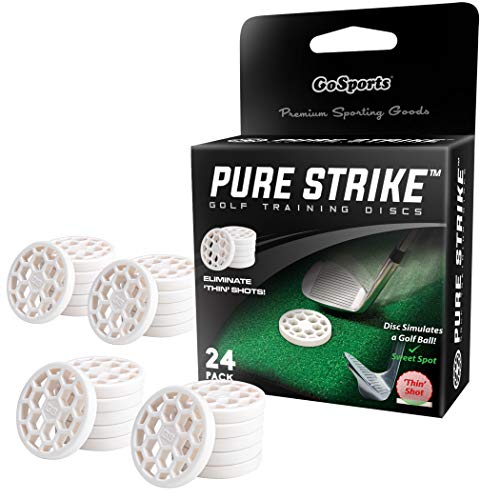
IMPROVE BALL CONTACT: Pure Strike Golf Training Discs help golfers practice cleaner ball-first contact and more consistent strikes while improving swing path, low point control and compression
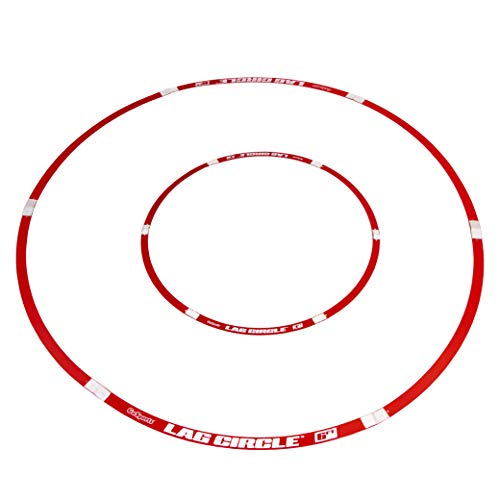
2 PIECE SET: 6 ft. circle for chipping and 3 ft. circle for putting; both circles can also be separated to form semi-circles

Developing Consistent Push Putt Mechanics
You’ll recognize that perfecting the push putt hinges on understanding its distinct mechanics. This putting style is distinguished from others by its straight-line release and minimal wrist action.
Analyzing your stance and arm movement is critical for a consistent release. This ensures that each putt replicates the same fluid motion. By rigorously training your muscle memory, you enhance precision and reduce variables that can affect your putting success.
Push Putt Mechanics
To master the push putt, you need to understand its fundamental mechanics. This starts with a smooth and deliberate motion originating from your lower body. Finger positioning is paramount; your grip must be firm yet sensitive, allowing for the disc to release cleanly at the end of the stroke.
Weight transfer is another critical component. You must shift your weight forward from your back leg to your front leg in a controlled manner, harnessing the momentum to propel the disc. This transfer should be fluid and in harmony with the arm’s pendulum-like motion.
Analyze each movement’s efficiency, ensuring that no energy is wasted and every action contributes to the putt’s precision. Mastery of these mechanics will lead to a putt that’s both accurate and consistent, embodying the freedom of flawless execution.
Training Consistent Release
Achieving consistency in your release is the cornerstone of mastering the push putt in disc golf. To refine this skill, you’ll need to engage in targeted putting drills that hone your muscle memory and enhance your mental focus. It’s not just about repetition; it’s about deliberate practice under varying conditions to simulate the freedom of play you’ll encounter on the course.
| Drill Type | Purpose |
|---|---|
| Staggered Putt | Adjust for stance variability |
| Metronome Timing | Sync breath with release |
| Pressure Simulation | Build resilience under competitive stress |
| Focal Point Training | Sharpen mental focus on release point |
Employ these drills methodically, analyzing each movement’s mechanics. Your goal is to internalize the motion until it’s second nature, allowing you to execute with precision under any circumstance.
Creating Your Hybrid Putting Style
Hybrid putting styles blend various techniques, allowing you to tailor your approach for increased accuracy and comfort on the disc golf course.
As you develop your unique method, consider the interplay of putting psychology and stance variations. It’s not simply about physical execution; your mental state drives focus and consistency.
By combining elements from traditional stances—such as spin, push, and straddle putts—you create a customized strategy that suits your playstyle and adapts to the course’s demands.
Analyzing your performance under various conditions, you’ll notice how hybrid styles offer the flexibility to navigate obstacles and wind patterns. This technical freedom isn’t just liberating; it’s a strategic advantage.
Developing a Straddle Putt
As you refine your hybrid technique, mastering the straddle putt will bolster your arsenal, offering stability and a clear line to the basket even in obstructive situations.
With legs spread parallel to the target line, your center of gravity lowers, affording you a solid base. It’s imperative that your mental focus remains sharp, as this stance can feel unnatural at first.
Incorporate putting drills that emphasize repetition and incremental difficulty. Begin with short-range putts to ingrain the mechanics before extending the distance. Analyze each attempt’s accuracy and stability, adjusting your form as needed.
| Aspect | Consideration |
|---|---|
| Stance | Wide, balanced, and stable |
| Arm Movement | Smooth, controlled, pendulum-like |
| Mental Focus | Unwavering concentration |
| Practice | Consistent, varied putting drills |
Your commitment to these practices ensures a straddle putt that’s both reliable and freeing.
The Turbo Putt Explained
As you refine your disc golf skills, understanding the turbo putt’s grip technique becomes crucial for mastering this unique throwing style.
Analyzing the turbo putt situations reveals when it’s most effective, relying on your ability to evaluate obstacles and wind conditions.
This section will break down the mechanics and strategic applications of the turbo putt, enhancing your repertoire for challenging courses.
Executing Technical Turbo Putt Grips
You’ll rarely encounter a putt as distinctive as the turbo putt, which relies on a unique grip to execute quick, lofted shots over obstacles. Mastering this throw hinges on precise finger positioning and deliberate wrist motion.
Position your fingers underneath the disc with your thumb on top, spreading them like the spokes of a wheel. This fan-like arrangement grants you control and stability.
Your wrist motion is equally critical. Snap your wrist upward as you release, imparting a spiral motion akin to a quarterback’s pass. This spin stabilizes the disc’s flight.
Analyze each component of your grip and tweak it for consistency. With practice, your turbo putt will transcend pure function, embodying the freedom of flight and precision in your game.
Turbo Putt Situations
In your repertoire of disc golf techniques, the turbo putt is a specialized move you’ll deploy when faced with challenging obstacles that block a traditional putt.
Its utility becomes evident in tight situations where obstacle navigation is paramount. Analyzing the tableau below, you’ll understand when to integrate this technique.
| Condition | Turbo Putt Benefit | Consideration |
|---|---|---|
| Dense Foliage | Clears low branches | Release angle precision |
| Windy Environments | Overcomes wind effects | Wind considerations |
| Elevated Targets | Direct vertical path | Power modulation |
| Obstacles Below | Avoids ground clutter | Disc stability control |
Assess the environment critically; the turbo putt not only circumvents physical barriers but also mitigates wind considerations. You’re not just tossing a disc—you’re crafting a flight with intention. Remember, freedom in disc golf comes from mastering such nuances.
Achieving Pinpoint Accuracy Through Distance Control
Mastering the art of distance control is essential for elevating your disc golf putt to the next level. A keen putting mindset, underpinned by unwavering stance stability, is the linchpin for achieving pinpoint accuracy over varied distances.
To refine this aspect, dissect your putting mechanics analytically. Observe the subtleties in wrist motion and finger pressure—variables that dictate the velocity and trajectory of your putt. Factor in wind conditions and elevation changes, calibrating your throw accordingly.
Incremental adjustments, rather than wholesale changes, often yield the most significant improvements. Embrace the notion of freedom within your technique, allowing for fluidity while maintaining a robust, repeatable process.
Success in distance control isn’t solely about power; it’s the precision born from a balanced synergy of mind and body.

The Aviar is a straight-flying Putt and Approach with a predictable finish. It is the most popular Putter of all time and has been used to win more World Championship titles than any other Putter.

Beaded Putter with Rounded Rim for Comfortable Grip

FLIGHT RATINGS - Speed 3, Glide 2, Turn 0, Fade 1