
You’re on the brink of upping your disc golf game. With a keen eye for detail and the freedom to refine your technique, delve into this methodical guide.
We’ll break down grip tactics, posture, and release angles, helping you to harness your innate potential. Through expert drills and seasoned advice, you’re set to transform your throws.
So, grasp the liberty of precision and let’s sculpt your skills to new heights.
Ready to master the course?
Mastering Disc Golf Grip Techniques
Mastery of grip techniques is crucial to elevating your disc golf game. Ensuring you’ve got the control you need to execute precise throws every time. Finger placement and thumb position are pivotal. They work in tandem to afford you the finesse and power integral to your freedom on the course.
Analyze your current grip. Are your fingers uniformly wrapped around the disc’s rim, or do you find variance in pressure? Your thumb, ideally, should be placed atop the disc, slightly off-center for balance. This strategic positioning is non-negotiable for stability during flight.
Methodically refine these aspects in your practice sessions. Remember, a disciplined approach to grip will liberate your throws, allowing for a flight path that’s both deliberate and unrestricted.
Cultivating Proper Stance and Posture
Building on your grip technique, it’s essential to focus on your stance and posture, as these elements form the foundation from which all your throws are executed. Proper body mechanics are paramount; they determine the efficiency and accuracy of your movements.
Analyze your posture by ensuring that you’re balanced with a slight bend in the knees, maintaining a low center of gravity. This balance training isn’t just about standing still; it’s about preparing your body to transition smoothly through the various phases of the throw.
Engage your core muscles and align your shoulders with your hips to create a stable axis for rotation. This disciplined approach to stance and posture liberates your technique, allowing for fluid motion and a release that capitalizes on both power and precision.

CORRECTS HAND POSITIONING ON EVERY SWING: Molded guide attaches to your club and places your fingers, thumbs, and palms in the correct neutral grip position; helps eliminate common faults like a strong grip, weak grip, or open right hand that lead to slicing and hooking


Training grip provides the correct hand position for the right golf grip
Mastering the Power Grip
Having established a stable stance and posture, you’ll now focus on honing your power grip to ensure maximum control and distance in your throws. Grip strength is paramount; it dictates the disc’s release and flight.
Begin by analyzing your finger positioning. Each finger must contribute to the grip, with the fingertips firmly pressed against the inner rim. Your thumb’s position on top of the disc provides balance and pressure against the fingers curled underneath.
For a methodical approach, practice gripping and releasing the disc, noting the consistency of your hold and the disc’s trajectory. Remember, a nuanced power grip isn’t about sheer force—it’s about strategic application.
Master your grip, and you’ll unlock a new level of freedom in your game, driving your disc further and with more precision.
Perfecting Your Release Angle
Understanding the significance of grip technique is paramount as you work toward perfecting your release angle. You’ll find that consistent practice focused on your release will result in more accurate and controlled throws.
Analyze your technique after each throw to ensure your release angle remains consistent—this is the key to elevating your disc golf game.
Grip Technique Importance
Your grip is the single most crucial element in determining the precision of your release angle in disc golf. The way you position your fingers on the disc, along with the type of disc you select, fundamentally influences the flight path.
Analyze your finger positioning for consistency; it should feel natural yet controlled. The grip must secure the disc, but not so tight that it hampers the release.
Disc selection is equally strategic. Each disc has unique flight characteristics, and the right choice complements your grip style, enhancing the release angle and overall throw precision.
Methodically practice with various grips and discs to understand how each combination affects your control. This level of meticulous adjustment is key to mastering your release and elevating your game.
Consistent Release Practice
To perfect your release angle, you’ll need to incorporate a series of targeted drills that focus on consistency and muscle memory.
Analyze your current release timing and disc stability during various throws, and methodically adjust to find the sweet spot. Consistent practice is key to ensuring the disc releases from your hand at the same angle every time, which is essential for precise shots.
Here’s a table of drills to enhance your release consistency:
| Drill Type | Objective |
|---|---|
| Mirror Drills | Refine release angle by mimicking the desired motion in front of a mirror. |
| Target Practice | Aim at specific points to improve precision and release timing. |
| Video Analysis | Study and correct release mechanics by reviewing footage of your throws. |
| Stability Workouts | Strengthen arm and wrist muscles for better control and disc stability. |
Embrace the drills that challenge your skills, and relish the freedom of mastering your craft.
Crafting Consistent Routines for Success
As you refine your disc golf skills, establishing a routine is pivotal to achieving consistency. You’ll need to analyze and replicate successful techniques daily, embedding them into muscle memory.
This structured approach ensures each throw you execute becomes a natural extension of practiced habits.
Routine Development
Developing a consistent routine sharpens your skills and ensures you’re prepared for every throw on the course.
To master this, dissect your throwing biomechanics, understanding each phase of your movement. Analyze your grip, stance, and release, refining these elements to automate your muscle memory. This methodical approach to practice fosters a reliable technique that withstands the pressures of competition.
Simultaneously, cultivate your mental focus. Visualize your throws, breathe purposefully, and develop cues that trigger a concentrated state. This mental conditioning guarantees that your head’s in the game, free from distractions.
Consistency Techniques
Your disc golf consistency hinges on the drills and routines you embed into your practice sessions. Cultivate a methodical approach by dissecting your driving mechanics and enhancing mental focus. Each action—from grip to follow-through—should be a deliberate part of your routine.
To captivate and maintain your interest, consider the table below. It’s a strategic framework for refining your consistency:
| Drill Category | Objective | Key Benefit |
|---|---|---|
| Warm-Up | Muscle Memory | Prepares body for consistent motion |
| Skill Work | Precision | Hones specific driving mechanics |
| Cool-Down | Mental Focus | Solidifies techniques; aids recovery |
Ingrain these elements into your regimen. Embrace the freedom to adjust, but remain disciplined in your execution. This balance will lead to the continual improvement of your game.
Daily Practice Habits
Every successful disc golfer knows that it’s your daily routines that lay the foundation for unmatched precision on the course.
To elevate your game, you must sharpen your throwing mechanics through repetitive, focused practice. Craft a schedule that includes daily drills to refine your grip, stance, and release. Analyze your movements methodically, ensuring each component of your throw is executed with deliberate control and efficiency.
Your mental focus is equally paramount, and it thrives on consistency. Dedicate time each day to visualize successful throws and rounds, reinforcing a mindset of confidence and clarity. This mental rehearsal paves the way for freedom on the course, allowing instinct and training to guide your performance seamlessly.
Sharpening Accuracy Through Fieldwork Drills
Fieldwork drills are essential in sharpening your disc golf accuracy, allowing you to analyze and refine each throw’s trajectory and landing zone.
Focus on your throwing mechanics; they’re the foundation of every successful shot. Be methodical in your approach, adjusting your grip, stance, and release point for consistency. Wind consideration is also pivotal; practice in various conditions to understand how it affects your disc’s flight.
Remember, you’re not just playing against the course, but also the elements.
| Emotion | Strategy |
|---|---|
| Confidence | Repeatedly practice your form |
| Frustration | Analyze and adjust after each throw |
| Determination | Set specific targets for landing zones |
| Elation | Master varied wind conditions |
Incorporating Dynamic Footwork
To elevate your game, you’ll need to integrate dynamic footwork drills that enhance your balance and power during each throw. Precise footwork is the foundation of your technique, dictating the efficiency of your movements and the resultant force applied to the disc.
Focus on balance training to solidify your stance and ensure a consistent release point. Implement footwork drills designed to improve agility and coordination, allowing for fluid transitions between steps. This methodical approach will refine your foot placements, optimizing the kinetic chain from the ground up.
Cultivate a regimen where each movement is deliberate and every step is purposeful. Embrace this discipline, and you’ll find greater command in your throws, embodying the freedom of peak performance.
Can Techniques for Total Control and Precision Also Help Improve Disc Golf Distance?
Mastering boost disc golf distance strategies enables players to achieve greater control and accuracy. By fine-tuning techniques for precision and power, such as adjusting grip, stance, and follow-through, players can improve their disc golf distance without sacrificing accuracy. Practice and technique refinement are key to achieving maximum distance on the fairway.
Analyzing and Adjusting Throws
Building on your improved footwork, you’ll now turn your attention to the meticulous analysis and adjustment of your throws, ensuring each motion propels the disc with maximum accuracy and control. Delve into the subtleties of throwing biomechanics; dissect the angle of release, the grip tension, and the follow-through. Each variable is a cog in an intricate machine, dictating the disc’s flight.
Mind the wind considerations as well. Like a seasoned sailor reading the sea, you must interpret the breeze. How it lifts, carries, or hampers your disc is crucial.
Adjust your stance, tweak your grip, and calibrate your release accordingly. You’re not just throwing; you’re commanding the elements, harnessing your freedom to adapt, and refining a skill set that transcends the mere act of play.
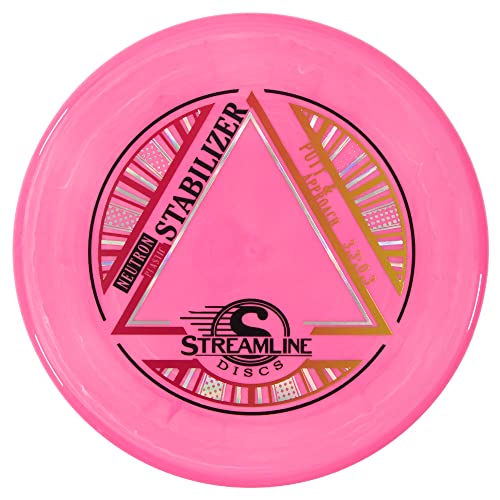
STREAMLINE STABILIZER - The Pilot is designed to be a go-to putter off the tee or on the approach! The Stabilizer has a similar hand feel and depth as the Neutron Pilot, but with a slightly raised shoulder and more pointed nose that produces a flatter and more stable putter.

Accurate swing technique: control your form using the golf swing training pad, which helps golfers maintain precise angles and transfer force optimally during practice,golf force pedal,golf yellow training pedal