
Sure, you could just slap your hand on the disc any which way, but if you want to throw with the grace of a gazelle rather than the accuracy of a blindfolded elephant, you’ll need to refine your grip.
You’re chasing that sweet spot where comfort and aerodynamics shake hands. Hold the disc as if it’s a delicate compass guiding you to victory, not a dinner plate you’re about to fling at a wall.
Your fingers are the crew, and the thumb is the captain; position them thoughtfully like you’re plotting a revolution against gravity. Whether it’s a two-finger grip or your palm boldly facing the horizon, you’ve got to feel the power as you prepare to unleash your disc.
So, go ahead, break free from the tyranny of bad form, and let your forehand fly with the liberty it deserves.
Grip Essentials
To establish a consistent forehand disc golf throw, you’ll need to master the essentials of a proper grip. The forehand grip is pivotal as it dictates the disc’s release and subsequent flight.
When exploring different grips, consider the power grip for long-distance throws. This grip involves wrapping your fingers tightly around the disc’s rim, with your thumb pressing down on top for control.
Remember, the grip should feel comfortable yet secure, allowing your arm’s motion to impart force along the disc’s axis during release.
Whether you’re adopting a stacked grip for more spin or a fan grip for precision, the key is aligning the grip with your unique throwing style.
A well-chosen forehand grip gives you the freedom to navigate the course with confidence.
Choosing Your Disc
Before diving into the nuances of your grip, it’s crucial that you select a disc that complements your forehand technique.
Your choice should encourage development while matching your current skill set. Look for discs that enhance control and require touch, rather than those that mask form flaws.
For your forehand throw, the rim of the disc is pivotal. Wider rims can be more challenging to grip for some forehand grips. Here’s a breakdown of disc characteristics to consider:
| Speed | Stability | Rim Width |
|---|---|---|
| Slow | Neutral | Narrow |
| Slow | Stable | Moderate |
| Fast | Overstable | Wide |
| Fast | Understable | Moderate |
| Medium | Flippy | Narrow |
Choose a disc that will not only fly well but also refine your technique.

RUBBERIZED GRIP DESIGN: Friction Gloves feature textured rubberized palms and fingers, creating steady disc control for drives and putts during disc golf rounds, outdoor play, and changing weather conditions.
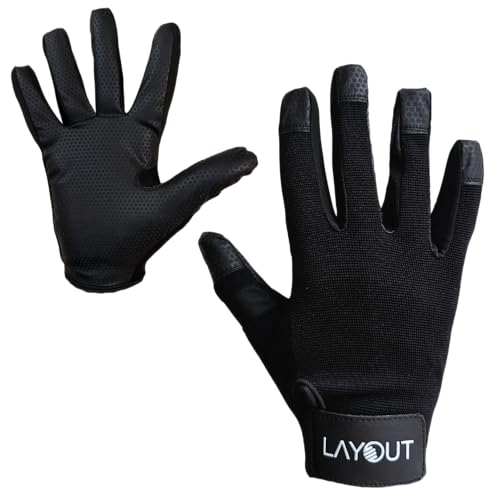
𝐌𝐎𝐑𝐄 𝐒𝐏𝐈𝐍, 𝐌𝐎𝐑𝐄 𝐃𝐈𝐒𝐓𝐀𝐍𝐂𝐄: Enhanced grip material increases disc RPM at release, which translates directly to longer, straighter drives off the tee and crisper throws under pressure in ultimate
Stance and Positioning
With your front foot slightly ahead and angled towards the target, you’ll establish a staggered stance that optimizes your forehand disc golf throw. This stance and positioning leverage the whole body’s mechanics, aligning your lead hip with the target to facilitate a fluid motion. Unlike the backhand, forehand throws don’t rely heavily on hip rotation, making your setup pivotal.
Ensure your feet, hips, and shoulders form a chain of alignment, pointing your right shoulder at the target for an open stance.
Your upper body plays a crucial role—keep your arm up and back to prevent strain. For that essential snap upon release, a subtle cocking of the wrist is key. Remember, precision trumps power, so align your form for accuracy and let the disc do the work.
Finger Placement Technique
Your finger placement technique is pivotal for mastering forehand disc golf throws.
Ensuring grip strength balance across your fingers will contribute to the disc’s stability and your control over its flight.
Precisely position your thumb to maintain pressure against the disc’s flight plate, optimizing your throw for both distance and accuracy.
Grip Strength Balance
Often, you’ll find that achieving the right balance in grip strength hinges on how you place your fingers on the disc. Precise finger positioning is essential—your pointer finger and middle finger are the keystones.
For a secure forehand grip, rest your middle finger along the disc’s bottom rim and your pointer finger against the outer edge, ensuring stability and control.
When executing the throw, making sure your grip isn’t too tight or too loose is vital; it’s about finding that sweet spot. A balanced grip allows for a smooth release and optimal spin, which are critical for accurate and powerful throws.
Thumb Positioning
Ensuring your thumb’s placement is critical, as it must rest atop the disc for a stable and controlled throw. For a good forehand, your thumb should apply pressure directly in the center of the disc’s flight plate. This central pressure helps maintain balance and ensures the disc flies true to your intended line.
To throw forehand effectively with two fingers, consider the following table which outlines optimal thumb positioning:
| Grip Style | Thumb Position | Result |
|---|---|---|
| Two-Finger | Center Pressure | Stability |
| Palm Parallel | Slight Offset | Enhanced Control |
| Palm Perpendicular | Directly Centered | Consistent Release |
| Power Grip | Near Disc Edge | Maximum Spin |
| Fan Grip | Spread Pressure | Feel and Touch |
Adapt your thumb placement to suit your style and the disc’s behavior for an optimal forehand throw.
Disc Stability Control
Adjusting finger placement on the rim allows you to fine-tune the disc’s stability as you execute your forehand throw. Disc stability control is paramount, and your fingers play a critical role. To mitigate the risk of rolling your wrist—a common error that leads to unstable shots—experiment with different types of grips.
A fan grip might afford more finesse, while a stacked grip could offer additional spin and stability.
The key is to find a finger position that complements your wrist motion, ensuring that the force applied during the throw remains perpendicular to the disc’s axis. This will enhance the disc’s spin, reducing off-axis torque and leading to a more controlled, accurate flight.
Thumb and Wrist Alignment
For optimal control and power in your forehand disc golf throw, your thumb should align directly atop the disc, with your wrist held firm to prevent wobbling.
Precise thumb placement ensures you’re able to throw with intention, anchoring the disc for a stable release. Your wrist alignment is equally critical; it should act as the fulcrum in your throwing motion. A wrist that’s too loose can sabotage your efforts, causing flutter and reducing distance.
Conversely, a wrist that’s too rigid can hinder the good snap necessary for maximum spin and speed. Strive for a balance where your wrist is flexible enough to whip through the throw yet firm enough to maintain disc orientation. This harmony between thumb position and wrist stability is the cornerstone of a powerful, accurate forehand.
The Power Pocket Concept
To master forehand throws in disc golf, you must understand the power pocket concept. This involves fine-tuning your arm angle and grip to ensure that energy is efficiently transferred to the disc. By doing so, you’ll increase your throw’s accuracy while minimizing erratic disc behavior.
The power pocket concept is crucial for optimizing release timing. It helps you to throw the disc at the right moment, maximizing the power generated from your body’s rotation. By mastering this concept, you’ll be able to generate more distance and velocity in your throws.
To achieve a proper power pocket, you need to focus on your arm angle and grip. Your arm should be bent at a 90-degree angle, with the disc held firmly in your hand. This allows you to generate torque and snap your wrist during the release, adding spin and stability to the disc’s flight.
In addition to the arm angle, your grip is also important. A proper grip ensures that the disc stays securely in your hand throughout the throw. Experiment with different grip styles to find the one that suits you best, but remember to keep it consistent to develop muscle memory.
Optimize Release Timing
Mastery of release timing is crucial to maximize the potential of the power pocket in your forehand disc golf throw. Imagine throwing a baseball; that efficient snap at the end is what you’re aiming for.
To optimize release timing, coordinate your arm’s whipping motion with the moment your wrist flicks the disc. This synergy unleashes the disc’s energy at the optimal point, akin to hitting a hammer’s sweet spot. Your goal is to create a perpendicular force along the disc’s rim, ensuring a tight, controlled spin.
With practice, this precise moment of release becomes second nature, reducing flutter and increasing distance. Embrace the freedom of a well-timed throw and watch your disc golf game elevate to new heights.
Arm Angle Efficiency
Understanding arm angle efficiency is essential when you’re developing a powerful forehand throw. This hinges on how effectively you leverage the ‘power pocket’ – the space created between your forearm and bicep during the throwing motion.
Unlike throwing a backhand, forehand disc golf requires a nuanced blend of wrist and arm mechanics. Your grip, whether palm parallel or perpendicular, must complement the arm’s trajectory to maintain arm angle efficiency. This precise angle ensures a force perpendicular to the disc’s axis, vital for a clean release.
As you refine your grip and wrist orientation, remember that the power pocket is where your throw’s potential energy is maximized. Mastery of this concept grants the freedom to execute forehand throws with both power and control.
Practice Drills
During your practice sessions, you’ll want to incorporate various grip and stance drills to refine your forehand technique. Experiment with grip variations, ensuring you keep your palm up throughout the throw. This orientation is the biggest thing to remember—it helps with disc stability and accuracy.
When you’re gonna throw, use mid-range or flippier discs to hone your touch and control. Focus on your footwork alignment too; it’s critical for a successful release.
Work diligently on wrist cocking and follow-through to generate that essential snap. The more you practice these elements with deliberate attention, the more your form will improve.
Consistent field work is key to minimizing injury risk and pushing your distances further. Remember, freedom in your game begins with disciplined practice.
Common Grip Mistakes
Many players inadvertently compromise their forehand throws by gripping the disc too tightly or too loosely, which can significantly affect accuracy and distance. When you’re trying to learn the correct form, it’s crucial to avoid these common grip mistakes.
Here’s a technical breakdown in a table format:
| Grip Error | Consequence | Correction |
|---|---|---|
| Too Tight | Limits wrist snap | Loosen grip slightly |
| Too Loose | Disc control loss | Firm up grip |
| Incorrect Finger Placement | Inconsistent release | Adjust to power grip |
| Thumb Position Off | Reduced spin | Place thumb closer to edge |
| Full Palm Contact | Hinders rotation | Only fingertips should touch |
What Are the Best Techniques for Mastering the Forehand Throw?
Learning the secrets to taming throws can dramatically improve your forehand technique. Mastering proper grip, body positioning, and follow-through are essential. Practice with a coach or experienced player to receive guidance and feedback. Film yourself to pinpoint areas for improvement and make necessary adjustments.
Conclusion
In conclusion, your forehand grip is vital for controlled, powerful throws. Ensure you’re comfortable with your disc choice and stance before honing your finger placement and wrist/thumb alignment. Remember, the power pocket is key for maximizing force.
Drill consistently to refine your grip and avoid common mistakes. There’s no one-size-fits-all grip, so keep experimenting until you find the sweet spot that complements your technique.
Practice diligently, and you’ll see your forehand throws soar with precision.

CORRECTS HAND POSITIONING ON EVERY SWING: Molded guide attaches to your club and places your fingers, thumbs, and palms in the correct neutral grip position; helps eliminate common faults like a strong grip, weak grip, or open right hand that lead to slicing and hooking

Training grip provides the correct hand position for the right golf grip

𝐌𝐎𝐑𝐄 𝐒𝐏𝐈𝐍 𝐎𝐍 𝐄𝐕𝐄𝐑𝐘 𝐓𝐇𝐑𝐎𝐖: The tacky synthetic leather palm gives your fingers the friction they need at the moment of release — so backhand drives, forehand shots, and approach throws all get more rotation and more consistent flight