
Thumbing through theories of thumber throws, you’ve likely landed on the belief that this unique technique is a blend of finesse and physics.
As you step onto the course, disc in hand, mastering the thumber throw can seem like a daunting task, but it’s one that can give you a competitive edge if you’re willing to put in the practice.
The grip is just the beginning; your stance, the wind-up, and the release all play pivotal roles in ensuring your disc soars accurately through the air.
To truly harness the power of the thumber throw, you must also consider the disc selection, understanding how each one can dramatically affect your throw’s trajectory and distance.
In the paragraphs that follow, you’ll explore the subtleties of this skill, uncovering strategies that could elevate your game to new heights.
Stick around to find out how you can transform your thumber throw from a mere trick shot into a reliable staple in your disc golf arsenal.
Understanding the Thumber Grip
Mastering the thumber grip, a technique often overlooked by novice players, can give you a significant edge in navigating tight fairways and executing overhand throws with precision. This unconventional grip allows for a unique flight pattern, capitalizing on speed and angle to circumvent obstacles.
You’ll place your thumb underneath the disc, pressing against the inner rim, while your fingers rest atop the flight plate. It’s crucial to ensure your thumb’s pad maintains firm contact to control the release.
Analyzing your disc’s design is imperative; a thicker rim provides a sturdier grip, enhancing stability during your throw. Experiment with various disc weights and compositions to optimize your control.
With practice, you’ll harness the thumber grip’s potential, liberating your game from traditional constraints and elevating your performance on the course.
Optimizing Your Stance and Footwork
Why should your stance matter as much as your grip when striving for disc golf throwing mastery?
Your body’s positioning serves as the foundation for the kinetic chain that culminates in a thumber throw. Proper stance aligns your skeletal structure, optimizing the transfer of energy from the ground up. To achieve this, you’ll need a balanced, athletic stance: feet shoulder-width apart, knees slightly bent, and weight distributed evenly.
When you initiate the throw, your footwork must be precise and deliberate. The lead foot steps forward, setting the pivot point, while the trailing foot drives rotational force. This nuanced dance is critical for consistency and power.
Ignoring stance and footwork is akin to overlooking the engine in a high-performance vehicle—it’s where the real magic happens.

MVP Disc Golf Starter Set Premium Set of 3 Discs

6-inch height Micro Disc Basket with Black Hole style

BEGINNER-FRIENDLY DISC GOLF SET: This disc golf discs set contains discs that are all suitable for beginners just getting into the game, and offers all you need to play a round. Each disc has been carefully selected to suit a beginners style of play and arm speed, allowing them to learn faster and improve their game right from the start
Disc Selection for Thumbers
Having established the importance of stance and footwork, let’s examine how selecting the right disc can further enhance your thumber throw’s effectiveness. For optimal thumber performance, you’ll need a disc that complements your arm speed and torque application.
Analyze the disc’s stability; overstable discs typically fare better, providing a predictable flight path and stronger resistance to wind. The disc’s rim configuration is crucial—look for a thicker rim that allows your thumb to nestle securely, granting you the control you crave.
Factor in the weight as well. Heavier discs tend to offer more consistency in flight, but they demand greater power. Conversely, lighter discs are more sensitive to nuances in release but can achieve greater distances with less effort.
Choose wisely to liberate your thumber’s potential.
Mastering the Wind-Up and Release
You must recognize that the wind-up is the foundation of your throwing technique, setting the stage for a powerful release.
Analyze your grip to ensure it maximizes the disc’s spin and stability, as this directly impacts your throw’s accuracy and distance.
Concurrently, aligning your body correctly not only optimizes power transfer but also significantly reduces the risk of injury during the wind-up phase.
Optimal Disc Grip Techniques
Mastering the optimal disc grip is essential, as it forms the foundation for the intricate wind-up dynamics pivotal to executing precise throws in disc golf.
Your grip must afford both control and fluidity, enabling unimpeded momentum transfer during the wind-up. Analyze your hand’s contact points with the disc; these should be firm yet not overly tense, to prevent torque loss.
The ‘power grip’—with all four fingers tucked tightly underneath the disc, thumb pressed atop—suits maximum distance drives, while a ‘fan grip’—fingers spread out beneath the disc—caters to finesse shots requiring touch and control.
Adjust your grip pressure in response to environmental variables; a nuanced approach here can mean the difference between a disc soaring through the chains or veering off course.
Body Alignment Strategies
Once your grip is refined, it’s crucial to align your body effectively, as proper posture and positioning are instrumental in harnessing the full potential of your wind-up dynamics.
Begin by orienting your feet in a staggered stance, ensuring a solid foundation. The lead foot should point towards your target while the trailing foot is perpendicular, establishing a stable axis for rotation.
Engage your hips and shoulders, synchronizing them with your arm’s motion. This kinetic chain maximizes torque and leverages momentum. A nuanced shift of weight from back to front foot as you wind-up amplifies power without compromising control.
Throwing Techniques Explained
Understanding the array of disc golf throwing techniques is crucial for players aiming to navigate varied course layouts with precision and control. You must dissect each method’s biomechanics to leverage your game’s finesse and power.
The thumber, for instance, demands a thumb-led grip and an overhand motion, capitalizing on an overhead release to surmount obstacles with a predictable left-to-right fade. It’s not mere wrist action; it’s a full-body commitment, integrating torque from your core and a follow-through that channels momentum.
Mastering the thumber isn’t about force but about understanding the disc’s aerodynamics—how it slices through air currents and responds to angular momentum. Your freedom on the course hinges on this technical prowess, transforming a simple throw into a strategic arsenal.
Release Points and Angles
You understand that mastering release points is crucial for precision in your disc golf game.
You’ll analyze your form to ensure that your release angle isn’t only consistent but also adaptable to various disc behaviors.
Evaluating each throw’s angle of release against the desired flight path will lead to incremental improvements in your performance.
Optimizing Release Timing
Mastering the precise timing of your release is crucial for controlling both the angle and the destination of your disc golf throw.
The exact moment when you let go determines the disc’s trajectory and its subsequent behavior. It’s a fine balance; release too early, and you’ll likely send the disc veering off to the right, too late and it’ll hook left more sharply than intended.
To optimize this timing, analyze your throwing motion in slow motion. Look for the point where your arm and the disc align with your target. That’s your optimal release point. Practice this with purpose, and you’ll develop a muscle memory that instinctively knows when to release, regardless of the external conditions.
Precision in release timing equals disc golf freedom, allowing your disc to soar as intended.
Angle Consistency Techniques
Achieving angle consistency in your disc golf throws hinges on mastering both the release points and the angles at which you release the disc.
The precise alignment of your body, the disc’s orientation, and your intended flight path are crucial. You’ll need to carefully calibrate your grip and stance to ensure that your release point is repeatable and appropriate for the desired throw trajectory.
Consider utilizing a fieldwork routine that emphasizes replicating specific disc angles under varied conditions. This hones your muscle memory and refines your proprioceptive awareness, essential for adjusting to unpredictable variables during play. Analysis of your throw in slow motion can reveal subtle inconsistencies, allowing for corrective adjustments.
Commit to this technical discipline, and you’ll experience the liberation that comes with reliable, precision throws on the course.
Improving Consistency Through Practice Drills
To elevate your disc golf game, it’s essential to engage in targeted practice drills that refine your throwing techniques and build muscle memory. Dedicate time to a regimen that includes both fieldwork and more nuanced skill exercises.
For fieldwork, focus on distance control by marking out incremental targets and strive to hit them with varying power levels. This drill hones your capacity to gauge and modulate throwing force.
Incorporate a ‘wind reading’ session, where you’ll assess and adapt to changing conditions, a critical skill in disc golf’s dynamic environments.
Technical drills, such as grip adjustments and release angle repetition, are imperative; they dissect your throw into controllable elements, allowing you to systematically eliminate weaknesses.
Consistent, analytical practice will free your game from inconsistencies and elevate your competitive edge.
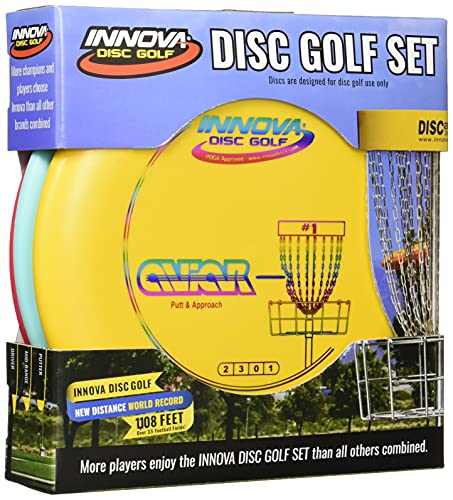
Complete Set: Includes One Driver, One Mid-Range And One Putter

QUIET - Reduces noice from basket chains for a quieter practice
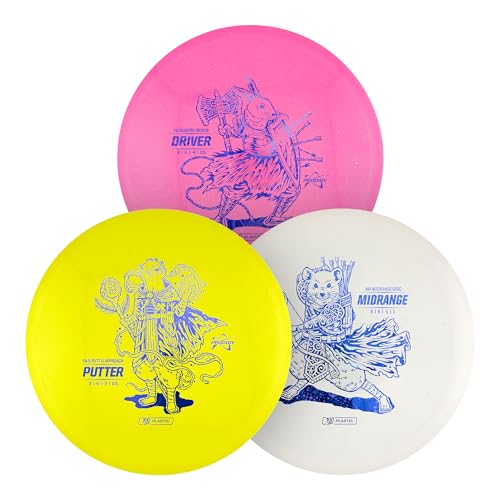
BEGINNER-FRIENDLY DISC GOLF SET: This disc golf discs set has been carefully put together to offer the right discs for a beginner just starting out. With a putter, midrange, and fairway driver this set offers exactly what you need to play your first round. Being lightweight and coming in an affordable plastic, these discs are made to help players excel from their first game and onwards