
You’re on the course, eyeing the slope ahead. It’s time to stop letting uphill throws intimidate you. With the right technique, you’ll conquer these inclines.
Assess the terrain, select your disc, and adjust your stance. Focus on the angle of release and power through with precision.
This guide breaks down the methodical approach to mastering uphill throws, giving you the freedom to elevate your game.
Get ready to turn those slopes into opportunities.
Assessing the Uphill Terrain
While you analyze the uphill terrain, it’s crucial to note the slope’s angle and the type of ground cover to optimize your disc selection and throwing technique.
Accurate slope calculation is paramount; it determines the disc’s trajectory needed to conquer gravity’s pull. A rangefinder or app can aid in this technical assessment.
You must also perform a meticulous terrain analysis. Assess the ground cover—whether it’s grassy, rocky, or muddy—as it affects the landing and roll of your disc. Choose a disc that complements the uphill grade; typically, a more understable disc is preferable, as it requires less power to achieve the desired altitude.
This methodical approach grants you the freedom to craft a strategic throw tailored to the landscape’s unique challenges.
Choosing the Right Disc
When selecting a disc for uphill play, you must analyze its stability to ensure it matches the slope’s demands.
You’ll also need to consider the disc’s weight, as heavier options can offer more control in windy conditions.
Lastly, understanding the flight patterns of your discs will enable you to execute shots that compensate for the uphill trajectory.

COMPLETE SET: This complete disc golf set from Franklin Sports is the perfect yard game for a family picnic, barbecue, or other get-together

Best choice for: Straight Line Driver, Anhyzer Shots and Roller Shots

PDGA Approved: This PDGA Approved U.S. Landmark disc set is 150 Class (145-150g) and includes 2 Putter (U.S. Capitol), 2 Mid-range (Statue of Liberty), 2 Driver (Golden Gate Bridge), and 1 Mini Maker
Disc Stability Selection
As you tackle uphill throws in disc golf, it’s crucial to select a disc with the right stability to match the incline’s challenge. Analyze the slope and wind conditions meticulously.
A stable to overstable disc is often your ally against the uphill battle, resisting the tendency to turn over under the increased angle of release necessary for elevation gain.
Consider disc materials; a grippier plastic can enhance your control during release, critical in executing precise grip techniques on varied terrain. Methodically evaluate your options, understanding that a disc’s stability is influenced by its design and your own throwing power.
Embrace this technical aspect with the freedom to experiment, but remember, consistency in your choice under similar conditions often leads to mastery.
Weight for Wind
How do you adjust your disc choice to accommodate the unpredictable gusts you’ll face on an uphill throw? The key lies in understanding wind dynamics and how they interact with disc weight.
Heavier discs offer more resistance to the wind, providing stability and predictability in your throw compensation. On the breezier days, opt for a weightier disc to counteract the lift and drift caused by a headwind. Conversely, a tailwind can add distance, but still demands a disc that won’t turn over easily.
Analyze the wind’s behavior, choose a disc that complements your throwing power, and adjust your angle of release accordingly. A methodical approach to disc selection empowers you to maintain control, ensuring your freedom to execute any shot, regardless of the uphill challenges.
Flight Pattern Considerations
Building on your understanding of wind dynamics, you’ll also need to factor in a disc’s flight pattern to conquer uphill throws effectively.
Disc selection is critical, as each disc’s unique aerodynamics will interact with wind influence, altering its trajectory. Release timing is paramount; a well-timed throw maximizes the desired flight path under varying conditions. Choose a disc that complements your technique and the slope’s demands.
| Disc Type | Wind Influence Adaptability | Ideal Release Timing |
|---|---|---|
| Overstable | High resistance | Early in strong wind |
| Stable | Moderate resistance | Neutral conditions |
| Understable | Susceptible to deviation | Late in calm scenarios |
Methodically analyze the slope’s angle and the wind’s direction. Select a disc whose stability will counteract the wind’s force, granting you the freedom to execute a strategic throw with precision.
Mastering Your Stance
You’ll find that balanced foot placement is foundational to executing a powerful and accurate throw.
Analyze the terrain and adjust your stance dynamically to maintain stability during your throw.
Balanced Foot Placement
In disc golf, your stance on uphill throws is pivotal; ensure your feet are positioned with stability in mind to maintain balance throughout your swing.
Analyze the hill’s gradient to optimize your driving technique, factoring in slope mechanics for a fluid motion. Your leading foot should anchor closer to the slope, providing a solid foundation.
| Foot Placement | Purpose |
|---|---|
| Leading Foot | Stability and balance on the incline |
| Trailing Foot | Power generation and follow-through |
| Weight Balance | Even distribution to prevent slipping |
| Stance Width | Adjust based on slope steepness |
This table underscores the strategic footwork necessary for mastery. Embrace this knowledge, and you’ll notice a newfound liberation in your game, as your throws ascend not only the terrain but your skill level as well.
Dynamic Stance Adjustments
Frequently adjusting your stance on uneven terrain is crucial to maintain control and precision in your uphill disc golf throws.
Angle adaptation isn’t just about the disc’s trajectory; it’s about tweaking your body’s orientation to the slope. Analyze the incline and adjust your feet accordingly—wider for stability or narrower for a more focused release.
Stance rotation is equally vital; your lead foot should point towards the target, aiding in force application.
Methodically practice these dynamic stance adjustments. Shift your weight forward as you ascend, ensuring your center of gravity promotes a smooth upward motion. This technical approach grants you the freedom to conquer diverse topographies, making your uphill game as limitless as your ambition to master it.
Adjusting Your Release Angle
When tackling uphill throws in disc golf, you need to adjust your release angle to compensate for elevation changes. Analyze the slope and recalibrate your release mechanics accordingly.
A steeper hill necessitates a higher angle of release, ensuring the disc doesn’t dive into the ground too early. Consider grip variation to maintain control and finesse during these adjustments.
To achieve this, angle your wrist slightly upward while maintaining a firm grip. This slight modification allows the disc to travel upward without sacrificing speed or stability.
Practice this technique methodically, focusing on the consistency of your release point.
Generating Power on the Slope
You’ll need additional power behind your throw to effectively tackle the uphill slope without compromising your disc’s trajectory.
To maintain slope speed and build elevation endurance, you must analyze your technique and the environment methodically. Here’s a table outlining key factors:
| Factor | Impact on Uphill Throw | Strategy |
|---|---|---|
| Disc Weight | Heavier discs resist wind | Use max weight |
| Body Position | Lower center of gravity aids power | Bend knees more |
| Arm Speed | Faster arm speed equals more power | Increase acceleration |
| Release Angle | Nose-up causes stalling | Slight nose-up |
| Footing | Slippage reduces power | Find stable ground |
Embrace these components to liberate your game from the constraints of gravity and terrain. Precision in your approach guarantees you’ll conquer the incline with finesse.
How Can Strategic Throws Improve My Disc Golf Game on Uphill Terrain?
Mastering the art of disc golf throws is essential for improving your game on uphill terrain. Strategic throws can help you navigate challenging slopes more effectively, allowing you to maintain control and accuracy. By understanding different throwing techniques and practicing regularly, you can conquer uphill obstacles and elevate your disc golf performance.
Practice Drills for Uphill Throws
To refine your uphill technique, incorporate targeted practice drills into your training regimen that focus on the specific strategies outlined above.
Begin with angle control exercises, which are vital for effective uphill throws. Set up markers at various elevations and practice releasing your disc at different angles, honing your ability to gauge the disc’s flight path in relation to the slope’s gradient.
Simultaneously, build your leg strength through repetitive lunges and squats. These movements mirror the lower body engagement required for uphill throws.
By combining these drills, you’ll develop a robust foundation that supports a powerful launch, even against gravity’s pull.
Methodically analyze each throw’s outcome, adjust your technique, and repeat, ensuring steady progress towards uphill mastery in disc golf.
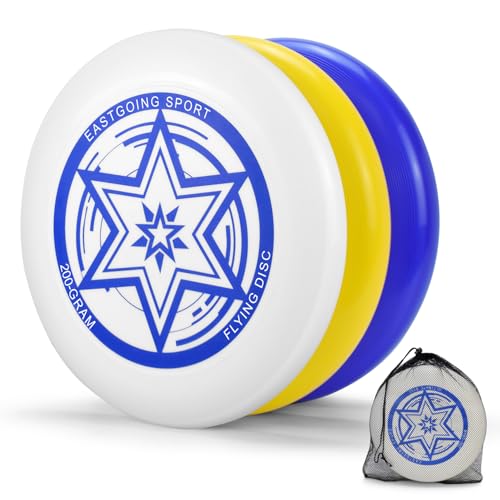
【Flying Disc Process】:3 different colors disc made of tough but stretchy Composite plastic and the graphics are UV digitally printed so the colors won't fade. The front and back of the Flying Disc are specially polished to provide adhesion, the edges are rounded to fit the arc of the palm, enhance the feel of the Flying Disc.

BIG KAHUNA INNMOLD - The Big Kahuna is the best choice for catch on the beach. Can also be used for backyards, picnics, or a game of catch anywhere.

BIG KAHUNA INNMOLD - The Big Kahuna is the best choice for catch on the beach. Can also be used for backyards, picnics, or a game of catch anywhere.