
You’re determined to elevate your disc golf game and throw hyzers like a pro. It’s all about technique, choice of disc, and understanding the physics at play.
This guide will dissect the pros’ strategies, from perfecting your grip and stance to mastering body movements and wind dynamics.
You’ll analyze your throws with a critical eye, making adjustments that’ll free your game from limitations.
Get ready to transform your hyzer throws with these 11 game changing tips.
Hyzer Flight Dynamics: The Science Behind Shaping Your Shot
Master the fundamental concept of a hyzer throw by envisioning it as a disc’s flight path angling towards the ground to your left if you’re right-handed, or to your right if you’re left-handed.
The hyzer physics dictate that the disc will naturally follow this path due to its gyroscopic stability when released with an edge that’s lower than the opposite side. Your release mechanics are crucial; you’ll need to angle your wrist and arm appropriately to achieve the desired hyzer angle.
For optimal control, you must align your shoulders with your intended hyzer line. Release the disc smoothly with a firm grip, ensuring the edge you want to hit the ground first is lower upon release. Fine-tune your technique to unlock the freedom of shaping your shots like a pro.
Balancing Disc Speed, Weight and Stability for Precision Hyzers
When selecting your disc, consider its stability, a key factor that influences flight path under various wind conditions.
You’ll need to balance weight and speed, as heavier discs offer more control while lighter ones can cover greater distances.
Analyze the course layout and wind patterns to match your disc choice to the specific hyzer shot required.
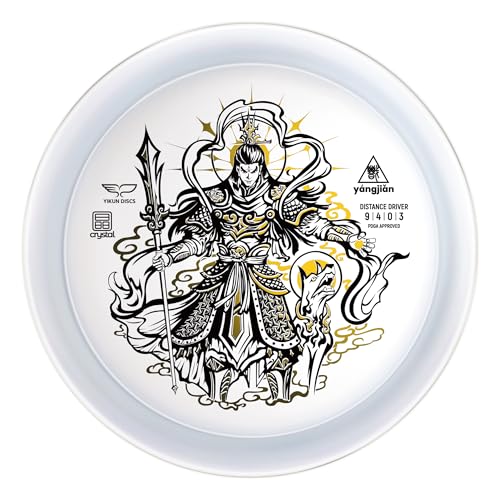
9-Speed Overstable Driver|Engineered with the highest stability rating in Yikun's lineup, its optimized rim width ensures comfortable grip for all skill levels. The disc maintains laser-straight flight before executing a strong hyzer finish, dominating in headwinds and dogleg maneuvers.

Official Collab · Limited Release| 2025 PDGA World Championships Commemorative Discs - 16 Tournament-Exclusive Designs! Featuring breakthrough "Crystal Series" & "Neon Line" technologies.

Best choice for: Straight Line Driver, Anhyzer Shots and Roller Shots
Disc Stability Selection
Understanding the intricacies of disc stability is crucial as you select the optimal disc for executing a hyzer shot. Disc stability refers to the disc’s tendency to resist turning over in flight and its ability to fade left (for a right-hand backhand throw).
When choosing a disc for hyzer throws, consider the disc color and how seasonal changes affect visibility and your psychological comfort. Opt for brighter colors in winter and more subdued ones in summer to maintain focus on your disc’s flight path.
Here’s a table to guide your selection:
| Stability Type | Description |
|---|---|
| Overstable | Resists turning, reliable fade. |
| Stable | Straight flight with predictable fade. |
| Understable | Turns right before fading left. |
| Very Overstable | Extreme resistance to turning. |
| Specialty | Designed for specific shots. |
Choose a disc that complements your power and technique for consistent hyzers.
Weight and Speed Balance
Your disc’s weight and speed are pivotal factors in achieving the precision required for a stellar hyzer shot. Disc golf pros understand the hyzer physics that dictate flight paths and adjust their release mechanics to accommodate.
A heavier disc tends to offer more stability and wind resistance, crucial for maintaining the hyzer angle in adverse conditions. Conversely, a lighter disc can provide greater control and finesse, aiding in the execution of a nuanced hyzer that navigates tight fairways.
Selecting a disc with a suitable speed rating is equally important. High-speed discs require more power and can exaggerate errors, while lower-speed discs afford more control and are forgiving on release.
Balance these elements to master hyzer shots that defy obstacles and land with precision.
Finding Your Optimal Hyzer Grip: Control vs Power
Consistently mastering hyzer throws in disc golf begins with perfecting the grip that you’ll frequently adjust based on wind conditions and the desired flight path. Optimal finger positioning is critical; your grip must be firm yet flexible, allowing for controlled wrist action.
The power grip, with all four fingers tucked tightly underneath the disc, offers maximum control for a pronounced hyzer. However, if you seek a more nuanced throw, consider a fan grip, spreading your fingers underneath the flight plate, which can offer more finesse.
Adjust your thumb placement for stability—too far on the edge and you’ll sacrifice control, too central and you may limit spin. Your grip’s tension should be balanced: too tight and you’ll hinder the disc’s release, too loose and the accuracy falters.
Building a Solid Foundation: Stance and Footwork Fundamentals
After refining your grip technique, focus on your stance; it’s the foundation for unleashing powerful and precise hyzers. Proper foot positioning and balance control are critical.
Position your lead foot slightly forward, aligning it with your target, while your trailing foot should be back at a comfortable distance, ensuring a stable base. This staggered stance maximizes your ability to rotate your hips and shoulders fully.
Concentrate on keeping your weight centered between your feet. As you initiate the throw, shift your weight smoothly from back to front, maintaining balance control. Avoid leaning too far in any direction, as this can compromise your power and accuracy.
Honing the Hyzer Reach Back: Timing, Extension and Body Synchrony
As you transition from your stance into the reach back, it’s crucial to extend your arm fully while maintaining a straight line with the target.
Pay close attention to the timing of your wrist snap; it’s the linchpin for maximizing spin and distance.
Ensure your body’s alignment supports a fluid motion, as this synchronizes your arm movement with your lower body to optimize the hyzer’s trajectory.
Proper Arm Extension
For optimal hyzer throws in disc golf, you’ll need to master the reach back with proper arm extension, ensuring your arm is straight and pulled back through the peak of the throw. Precise wrist positioning and elbow mechanics are crucial. Your wrist should remain firm yet flexible, ready to snap forward at the end of the reach back.
Keep your elbow slightly bent to maximize control and minimize strain, but extend it fully as you come through the throwing motion. This full extension generates the power and angle necessary for a successful hyzer.
Analyze your technique: Are you maintaining a straight line from shoulder to disc? Is your timing synchronized with your lower body’s rotation? Perfecting these elements will unlock the freedom and excellence you seek on the course.
Timing the Snap
Building on your arm extension, you’ll need to nail the timing of the snap to launch your disc golf hyzer with precision and power.
Snap consistency is key; it’s the critical moment where you transfer all the built-up energy into the disc. To achieve this, practice release drills that focus on the synchronization of your arm’s reach back and the forward motion.
Imagine your arm motion segmented into three phases:
| Reach Back | Transition | Snap Release |
|---|---|---|
| Full extension away from the body | Elbow leads, disc follows | Wrist flicks decisively |
| Eyes on target | Body uncoils, aligning with the throw | Timing peaks with arm speed |
| Disc angled for hyzer | Hips rotate, leveraging power | Follow-through directs flight path |
These components are interconnected, and mastering the reach back sets the stage for a powerful, controlled snap.
Body Alignment Technique
To master the reach back in your hyzer throws, you’ll need to ensure your body’s alignment is precise, with your shoulders, hips, and feet all working in harmony.
Begin with your feet shoulder-width apart, toes slightly outwards. As you initiate the reach back, focus on a smooth hip rotation, driving the motion. Your rear hip should turn away while the front hip pivots inward, creating a torque that will later unleash power.
Simultaneously, your shoulder alignment dictates the disc’s trajectory. Keep your throwing shoulder slightly lower than your non-throwing shoulder, aligning with the intended flight path. This position locks in the angle of release, crucial for a consistent hyzer.
Pinpointing the Perfect Hyzer Release: Consistency, Visualization and Body Rhythms
Mastering the release point is crucial for achieving precise and curved hyzer shots, which is a skill consistently demonstrated by top disc golf professionals.
Release consistency plays a paramount role in executing hyzer shots effectively. To visualize the throw as a well-coordinated mechanism, every element, starting from the grip to the follow-through, must be in sync.
For optimal timing, it is important to focus on the peak of your reach back. As you begin the forward swing, it is essential to stay in tune with your body’s rhythm, allowing your arm to smoothly whip through. The exact moment when your arm passes your front leg is a critical cue for the release.
Releasing too early or too late will compromise the flight path of your hyzer shot. Mastering this timing will grant you the freedom to shape shots like a professional, with every disc soaring exactly as intended.
Generating Powerful Hyzer Spin: Master the Wrist Snap
You’ll find that adding more spin to your disc not only stabilizes its flight but also enhances the hyzer angle throughout its trajectory.
To maximize spin, focus on the spin dynamics by applying more rotational torque during your throw. This means gripping the disc firmly and snapping your wrist authoritatively as you release. The wrist snap is crucial; it’s the primary source of your disc’s spin.
Understand that the rotational torque you impart counters the disc’s natural tendency to fade, maintaining the desired hyzer line longer. For consistency, practice your wrist snap without sacrificing control. Remember, it’s not just about power; it’s the precision of the spin that dictates stability.
Mastering this spin allows your disc to defy the wind’s will, claiming a flight path that you dictate.
Shaping Hyzers Through Release Adjustments
Building on your enhanced spin technique, you’ll now adjust the angle of release and the disc’s elevation to shape your hyzer throws with precision.
To minimize hyzer mistakes, focus on the angle at which you grip and release the disc. A consistent, controlled angle ensures the disc will follow the desired hyzer flight path.
When it comes to elevation adaptation, assess the terrain and wind conditions. Slight modifications to your release point can combat elevation changes, whether you’re facing an uphill or downhill trajectory.
Release lower to the ground for uphill shots to maximize control. Conversely, a higher release suits downhill throws, allowing gravity to complement the hyzer’s curve.
Master these variables, and you’ll conquer any course with a newfound sense of freedom.
Adapting Your Hyzer to Various Wind Scenarios
You’ll need to adjust your strategy when you’re throwing in a tailwind. It tends to push the disc down, requiring a higher angle of release to maintain lift.
Conversely, selecting the right disc in a headwind is critical. Opt for something more stable to combat the increased lift and unpredictable flight patterns.
Master these conditions, and you’ll maintain control over your hyzers, regardless of the wind’s direction.
Tailwind Hyzer Strategy
Master the tailwind hyzer by choosing a more stable disc to capitalize on the wind’s force, ensuring a precise and controlled flight path.
The tailwind compresses the disc’s flight, demanding a calculated approach. Acknowledge the crosswind impact; it can subtly alter the disc’s trajectory. To counteract this, integrate release adjustments into your strategy. Release the disc with a slightly elevated nose angle, allowing the tailwind to push it down into a hyzer angle more aggressively.
When the wind is at your back, it’s your ally. Exploit its push to reduce the disc’s fade, enhancing distance without sacrificing accuracy. Stay analytical about your surroundings, adjust your grip and stance accordingly, and you’ll harness the freedom the wind offers, transforming it into a tool for your hyzer mastery.
Headwind Disc Selection
In the face of a headwind, you’ll need a heavier, overstable disc to maintain control and execute a consistent hyzer.
The right disc selection is crucial, as is your mental preparation. Choose a disc that won’t turn over in the wind, which often means reaching for something with a higher weight and stability rating.
Remember, disc color can play a role in your confidence and focus, so select one that stands out against the sky for better tracking.
| Stability | Weight Range | Emotional Impact |
|---|---|---|
| Overstable | 170-175g | Confidence |
| Stable | 165-169g | Determination |
| Understable | <165g | Caution |
Incorporating Body Movement
During your hyzer throws, coordinating your arm, hip, and leg movements is essential for generating the power and precision that professionals achieve. You’ll need to harness rotational energy efficiently. Begin with your stance, ensuring a firm footing to provide a stable base.
As you initiate your throw, engage your hips first, creating a foundation for your upper body to follow. This hip action is critical—it’s the catalyst for the kinetic chain reaction needed for a powerful release.
Follow through with shoulder engagement, rotating smoothly but forcefully. Your shoulder acts as a pivot, guiding your arm in a controlled, curved path. Keep your movements fluid to maintain continuous momentum.
When executed correctly, this synchrony of body mechanics maximizes your throw’s velocity and accuracy, offering you the liberating sensation of mastering the hyzer.
Fine-Tuning Your Hyzer Step-by-Step Through Throw Analysis
Throw analysis, a crucial component of honing your hyzer technique, allows you to pinpoint areas in need of refinement and make precise adjustments to your form.
Examine your driving mechanics, focusing on the grip, arm angle, and release point. Is your grip firm yet relaxed, maximizing control without tension? Does your arm angle consistently align with your desired hyzer trajectory? Observe your release point—any inconsistency here can drastically alter your disc’s flight.
Mental preparation is equally vital. Visualize the flight path before each throw. This cognitive rehearsal translates to muscle memory, fostering a seamless blend of intention and execution. Remember, adjustments aren’t just about physical corrections; they’re about fine-tuning your mindset to embody the freedom and confidence of a pro.

【PDGA Official Tournament Certified】Fully approved by the Professional Disc Golf Association, this scented HAMMER putter meets official competition standards. It is tournament-legal for all PDGA sanctioned matches, professional competitions and daily skill training, supporting formal competitive gameplay.

ABOUT THE BOLT – The Gravity Bolt is a lightweight distance driver disc designed for beginners and players with slower arm speeds. Part of Latitude 64’s Easy to Use line, it weighs just 120-130g and features an understable flight and high glide, helping newer players achieve longer throws without needing maximum power

ABOUT THE BOLT – The Gravity Bolt is a lightweight distance driver disc designed for beginners and players with slower arm speeds. Part of Latitude 64’s Easy to Use line, it weighs just 120-130g and features an understable flight and high glide, helping newer players achieve longer throws without needing maximum power