
You watch the pros, you practice your throws, you strive to perfect your game. But have you ever really dissected what makes a disc golf throw successful?
‘Unlock Your Disc Golf Potential: Mastering Pro Techniques’ is your guide to doing just that. It helps you analyze the nuanced techniques of the pros, understand the common blunders you’re likely to make, and develop strategies for crafting your ideal throw.
This book dives deep into the biomechanics of disc golf, offering insights into grip styles, stance, and the all-important body mechanics. By personalizing your approach and implementing the practice drills provided, you’ll refine your skills and gain the consistency you need to elevate your game.
Analyzing Pro Throwing Techniques
When you watch professional disc golfers, you’ll notice each player has refined their throwing technique to maximize precision and distance. Proper form is fundamental, starting with a consistent stance and a smooth run-up.
As they reach the point of release, the disc is held with a firm yet supple grip, allowing for a controlled snap. The angle of release is meticulously adjusted; for instance, when throwing a hyzer, the disc is released with a tilt, ensuring it banks left for a right-handed backhand throw (or right for a left-handed throw).
Pros understand that the angle at which they release the disc significantly affects its flight path. Through countless repetitions, they’ve honed the muscle memory needed to execute these movements with remarkable consistency.
Pinpointing Common Form Pitfalls
As you refine your disc golf skills, it’s crucial to recognize grip consistency issues that can undermine the accuracy and distance of your throws.
An incorrect stance or posture not only hampers your power but also your ability to control the disc’s flight path.
Moreover, poor follow-through execution can lead to erratic throws and diminish the potential for developing a reliable muscle memory for your game.

DESIGNED FOR DISC GOLFERS, BY DISC GOLFERS — Available in multiple designs for every type of player. Stupid Tree for the ones who blame the course. Parked. for the minimalists. Flight Path for the ones who need to understand the physics first.

DESIGNED FOR DISC GOLFERS, BY DISC GOLFERS — Available in multiple designs for every type of player. Stupid Tree for the ones who blame the course. Parked. for the minimalists. Flight Path for the ones who need to understand the physics first.

Mid-range golf driver
Grip Consistency Issues
Your grip forms the foundation of your disc golf throw, and inconsistencies here can wreak havoc on your game.
Grip consistency issues can prevent you from releasing the disc as intended, leading to erratic flights and missed targets. It’s critical to grip the disc uniformly each time to foster muscle memory and ensure a stable flight path.
| Consistent Grip Benefit | Impact on Throw |
|---|---|
| Improved Accuracy | Straighter Lines |
| Enhanced Distance | Greater Length |
| Reliable Muscle Memory | Predictable Throws |
| Stable Disc Flight | Desired Paths |
Ensuring that you throw the disc with a consistent grip, coupled with good follow-through, is paramount. This consistency minimizes variables in your throw, giving you control over the disc’s stability and trajectory.
Incorrect Stance/Posture
In addition to mastering a consistent grip, you’ll need to correct your stance and posture to further refine your disc golf throw.
Many disc golfers underestimate how an incorrect stance/posture can disrupt balance and precision. The important thing to remember when you throw a disc is maintaining proper balance and even weight distribution between your feet. If you find yourself falling off to one side or lurching forward upon release, it’s a clear indicator of imbalance.
Start by practicing your weight transfer without a run-up to internalize the feel of a balanced setup. This approach helps pinpoint flaws in your stance and posture, which are essential for a controlled and effective throw.
Always aim for a posture that supports a balanced and powerful disc golf drive.
Poor Follow-Through Execution
Having refined your grip, stance, and posture, it’s crucial you also master the follow-through to ensure your disc golf throws are both powerful and accurate.
An incomplete follow-through can cause the disc to fly erratically, reducing throw accuracy. When pulling the disc through, focus on the form evolution that allows a full extension of the arm and a natural unwinding of the body.
Here’s a quick comparison of do’s and don’ts:
| Proper Follow-Through | Poor Follow-Through |
|---|---|
| Full arm extension | Arm cut short |
| Body faces the target | Body remains sideways |
| Smooth release of the disc | Jerky or forced release |
| Balanced finish | Off-balance stance |
Ensure that your follow-through completes the energy transfer, maximizes disc control, and minimizes injury risk.
Choosing the Optimal Grip Style
Selecting the right grip style is crucial as it directly affects both the power and accuracy of your throw in disc golf.
When you’re executing a right-handed backhand, a power grip can maximize distance by allowing you to pull the disc through with more force. However, this grip may sacrifice some control.
Conversely, the fan grip offers precision by spreading your fingers for a balanced release, but it might limit your power.
Understanding how grip styles influence the disc’s flight is key; for instance, adjusting your grip can alter the anhyzer angle of your throw. It’s about finding a balance between finger placement and pressure to control your disc’s speed and stability.
Mastering varied grips will enable you to navigate diverse course challenges effectively.
Stance and Footwork Fundamentals
You’ll find that a balanced starting position is the foundation of any effective disc golf throw, setting the stage for controlled power and precision.
As you progress to a dynamic step sequence, it’s critical to understand how each movement contributes to the trajectory and stability of your throw.
Mastering the timing of your footwork, meanwhile, is essential in synchronizing your body’s mechanics to unleash consistent, accurate shots.
Balanced Starting Position
To achieve a powerful drive in disc golf, you must start with a balanced stance, distributing your weight evenly between both feet.
As a disc golfer, your balanced starting position is foundational, directly affecting your ability to throw with precision and power. Form evolution in disc golf emphasizes the importance of this equilibrium. Proper posture, with weight shared equally across the front and back foot, sets you up for successful weight transfer during the throw.
If you find yourself falling off to one side or lurching forward upon release, it’s a clear sign your balance is off, which can severely impact your aim. Start by practicing your balance and weight transfer statically, without a run-up. This drill helps you internalize the feel and scrutinize any flaws, ultimately refining your technique for the course.
Dynamic Step Sequence
Mastering your dynamic step sequence is essential for translating that balanced starting position into a fluid, powerful drive. As you learn how to throw with precision, understand that each movement in your footwork pattern impacts the disc turn and the resulting flight path.
A proper step sequence allows for efficient weight transfer, which is vital for control and power. Pay close attention to how seasoned players throw; their steps are deliberate and contribute to a consistent release angle and point.
Manipulating spin and accounting for wind and disc stability can vastly alter your disc’s trajectory. Analyze and refine your footwork to ensure that your drives aren’t just strong, but also meticulously accurate.
Footwork Timing Mastery
Consistently refining your footwork timing is as critical as the steps themselves, affecting your stance and the ultimate precision of your throws.
As you stand, poised to launch the flying disc, understand that each component of your movement contributes to the stability of the disc. Mastery of footwork timing ensures that from the run-up to the follow-through, every element is synchronized.
Imagine footwork as the conductor of an orchestra; if off-beat, the entire ensemble falters. Likewise, one throw can unravel if your footwork is out of sync.
By focusing on the fundamentals of your stance and the rhythm of your steps, you’ll harness the control needed to manipulate release angle and point, vital for shots like the turnover drive.
Embrace footwork timing mastery as the bedrock of your technique.
The Role of Body Mechanics
You’ll need to hone in on your body mechanics to elevate your disc golf game, focusing on how each segment of your body contributes to the power and accuracy of your throw.
Proper balance and weight transfer are foundational, ensuring a stable setup for effective backhand drives. As you progress through form evolution, muscle memory becomes your ally, developed through repetitive, conscious practice. This is where learning through feel becomes indispensable, carving the right movements into your long-term memory.
For the disc to be thrown with precision, each motion from the reach back to the follow-through must be executed with intent. Mastery of body mechanics means manipulating release angle, point, and trajectory to keep the disc flying straight, irrespective of wind or disc stability.
Personalizing Your Throwing Strategy
Refining your body mechanics is just the start; now it’s time to tailor your throwing strategy, ensuring it aligns with your unique strengths and comfort zone.
Personalizing your throwing strategy is an important part of the game. A different approach may be necessary depending on the hole’s layout, wind conditions, and your current skill set.
Here’s a table to conceptualize strategic adjustments:
| Factor | Adjustment Example | Purpose |
|---|---|---|
| Disc Stability | Use more understable discs | For turnover shots |
| Wind Condition | Adjust grip and release angle | To maintain control |
| Desired Flight | Modify spin and speed | Whether disc flies straight or curves |
| Personal Comfort | Choose standstill or run-up | For consistent weight transfer |
Analyzing each throw allows you to tweak these elements, cultivating a technique that feels natural and is effective on the course.
Practice Drills for Consistency
To bridge the gap between personal strategy and consistent execution, you need to incorporate targeted practice drills into your routine.
A fundamental exercise is the Straight Line drill, which helps develop a direct path for your arm when it comes to throwing. This drill emphasizes maintaining your arm and disc on a linear trajectory, reinforcing muscle memory for a straight release.
Engaging in practice drills for consistency is essential to internalize the sensations of proper balance and weight transfer, particularly during backhand drives. Stand still and focus on shifting your weight smoothly from your back foot to your front foot, without a run-up, to pinpoint and correct any technical flaws.
This approach ensures that your body learns the correct mechanics, leading to more consistent and accurate throws.
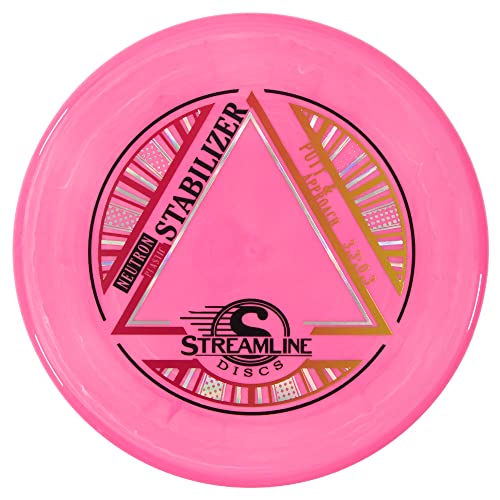
STREAMLINE STABILIZER - The Pilot is designed to be a go-to putter off the tee or on the approach! The Stabilizer has a similar hand feel and depth as the Neutron Pilot, but with a slightly raised shoulder and more pointed nose that produces a flatter and more stable putter.

Accurate swing technique: control your form using the golf swing training pad, which helps golfers maintain precise angles and transfer force optimally during practice,golf force pedal,golf yellow training pedal