
Over 75% of disc golf players believe wind is the most challenging natural element they face. You’re not alone if you’ve struggled to maintain control of your disc in gusty conditions.
‘Wind Whispers’ is your guide to understanding and adapting to the breeze that shapes the flight of your disc. You’ll learn how to read wind patterns, select the right discs, and adjust your throwing techniques to keep your game on course.
It’s about finding the sweet spot where skill and wind conditions meet, giving you the freedom to play with confidence, no matter how much the trees sway.
Dive into the strategies that’ll help you master the art of flight, and turn those whispers of wind into a conversation you dominate.
Understanding and Adapting to Wind Effects
Wind’s unpredictable nature means you’ll often face a complex challenge when adjusting your disc golf technique to accommodate its effects. Analyzing the sustainability of wind speed is crucial; intermittent gusts may disrupt less than constant high winds.
You should assess the course layout—opt for those with dense tree coverage or strategic leeward positioning on hills to mitigate wind interference. Understanding that wind speed doesn’t act uniformly, you’ll need to adapt dynamically. Your ability to harness wind’s variability and factor it into your throws will dictate your success on the course.
It’s about precision in your response to the capricious gusts. Embrace the challenge, engage with the elements, and you’ll navigate the course with a liberated, yet calculated, approach.
Smart Disc Selection Strategy
In optimizing your disc golf game against the wind, you must first consider the stability rating of your discs; a higher rating typically signifies better performance in headwinds.
You’ll need to factor in wind speed to decide whether to reach for a heavier disc, which offers more resistance to wind-induced variability.
Lastly, selecting the appropriate disc weight is crucial, as lighter discs can be advantageous in a tailwind but may falter in gustier conditions.
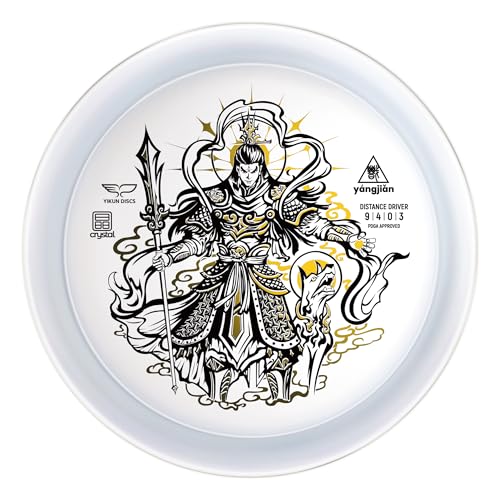
9-Speed Overstable Driver|Engineered with the highest stability rating in Yikun's lineup, its optimized rim width ensures comfortable grip for all skill levels. The disc maintains laser-straight flight before executing a strong hyzer finish, dominating in headwinds and dogleg maneuvers.

Midrange Approach Disc that can Handle Power

ABOUT THE WALKER - The Walker is an ultra overstable midrange that will be the perfect approach or headwind-fighting disc in your bag. This is a tank of a disc, and it will handle whatever you can throw at it!
Stability Rating Importance
Your disc’s stability rating is a vital tool for strategizing your selection to counteract the wind’s unpredictable effects on your game.
Understanding the stability rating importance allows you to wield the wind to your advantage, rather than falling victim to its whims. Here’s a table to guide your strategy:
| Wind Condition | Disc Stability Suggestion |
|---|---|
| Headwind | High Stability (Overstable) |
| Tailwind | Low Stability (Understable) |
| Crosswind | Neutral Stability (Stable) |
Selecting a disc with a higher stability rating ensures it can withstand the headwind’s force. Conversely, a lower stability disc will ride a tailwind better, increasing distance. For crosswinds, a neutrally stable disc minimizes erratic behavior, granting you a measure of control.
Your analytical approach to stability ratings underpins the freedom to shape your shots despite the wind’s challenges.
Wind Speed Considerations
Assess the day’s wind conditions carefully before selecting your discs, as the right choice can significantly influence your game’s outcome.
When confronting headwinds, opt for discs with a higher speed and stability rating; these characteristics align with the physics of flight, ensuring that your disc maintains its intended trajectory despite the oncoming resistance.
Conversely, tailor your selection for tailwinds by choosing slower, less stable discs that can ride the airstream and maximize distance. Your arm speed also plays a pivotal role; a disc that complements your throwing velocity in relation to the wind’s force will yield the best performance.
Adapt your strategy to harness the wind’s variability and turn it into an asset on the course.
Disc Weight Choices
While you tailor your disc selection to wind speed and stability, don’t overlook the importance of disc weight, which can be a game-changer in windy conditions. Heavier discs offer superior wind resistance, providing a consistent flight path when battling headwinds.
Conversely, a lighter disc may harness tailwinds more effectively, achieving greater distance with less effort. Your strategy should involve a meticulous analysis of the wind’s force and direction, adjusting your favorite disc choice accordingly.
Opt for maximum weight when headwinds threaten to destabilize your throw, and lean towards a lighter disc to exploit a supportive tailwind. Mastery of this technical aspect can liberate your game from the whims of the wind, allowing for precision and control regardless of the challenging conditions.
Adjusting Throws for Wind Conditions
As you confront the whims of the wind, you’ll need to refine your grip to maintain control over your disc’s stability and direction.
Modulating your power is crucial; too much force in a headwind can overthrow the target, while too little in a tailwind can cut your distance short.
Precise adjustments to your release angle will counteract the wind’s effect on your disc, ensuring a flight path that optimizes accuracy and distance.
Grip Modifications
You’ll often need to adjust your grip on the disc to maintain control in varying wind conditions. When a headwind challenges your throw, a firmer grip on a heavier, stable flying disc ensures a lower trajectory and mitigates wind interference.
In contrast, a lighter touch is paramount when tailwinds assist your flight—the disc requires less force to achieve distance, demanding finesse over power.
For crosswinds, your grip and release angle must counteract the aerodynamic forces attempting to divert your disc off-course. A controlled grip that allows for a hyzer angle, where the disc’s edge is tilted downward, can stabilize its flight against left-to-right or right-to-left gusts.
Mastery of grip modifications empowers you to harness the wind, not be hindered by it.
Power Control
Mastering power control is just as vital as selecting the right disc, as you must adjust your throwing strength to match the wind’s intensity.
In headwinds, increase your power to maintain stability; in tailwinds, decrease it to avoid overshooting your target. Crosswinds demand finesse—throwing with too much power can exacerbate the wind’s influence on your disc.
| Wind Condition | Power Adjustment |
|---|---|
| Headwind | Increase power |
| Tailwind | Decrease power |
| Left Crosswind | Adjust leftward |
| Right Crosswind | Adjust rightward |
Control your power output with precision, considering the Dynamic Discs Getaway’s behavior in the wind. It’s about harnessing freedom within the elements, letting you dictate the disc’s flight rather than being at the mercy of the wind.
Release Angle Adjustments
Beyond controlling your power, you’ll need to fine-tune your disc’s release angle to combat the whims of the wind effectively.
The science of release angle adjustments is key; a headwind demands a flatter release to mitigate unwanted lift, while a tailwind allows for a slight anhyzer to leverage the wind’s push for distance.
In a crosswind, your disc’s orientation is critical. A right-to-left gust requires a slight hyzer, ensuring the disc’s edge doesn’t catch the wind and veer off. Conversely, when facing a left-to-right breeze, tilt the disc with an anhyzer to maintain a straighter trajectory.
Each release angle adjustment is a calculated decision, vital for maintaining control and capitalizing on the wind’s fickle nature.
Reading Wind Patterns on the Course
In the midst of gusts and lulls, you need to become adept at reading the wind’s subtle cues to maintain control over your disc’s flight.
Disc Golf demands precision, and understanding the wind patterns is crucial for that finesse. Analyze the environment; tree movements, flags, and even grass can be indicators of wind direction and intensity.
This technical skill gives you the freedom to choose the best approach for each throw.
| Indicator | Emotion Evoked |
|---|---|
| Tree sway | Unease |
| Flag direction | Anticipation |
| Grass tilt | Curiosity |
| Cloud movement | Awe |
| Water ripples | Tranquility |
These natural cues are your allies, informing decisions that keep your disc soaring true, even when the wind whispers challenges.
Knowing When Wind Speeds Are Unplayable
While you may relish the challenge, it’s crucial to acknowledge that extremely high wind speeds can render a disc golf course nearly unplayable.
Discerning the wind speed limitations is a technical endeavor, demanding a granular analysis of sustainable speeds versus peak gusts. A disc’s aerodynamic stability is compromised beyond a certain threshold, where skill is overshadowed by sheer randomness.
This threshold varies among players; however, a consensus emerges around conditions where winds consistently exceed 30 mph, turning the game into an unpredictable spectacle.
To maintain the spirit of freedom in play, selecting courses with natural barriers such as dense woodlands or strategically placed on leeward hillsides offers a refuge from the relentless force.
Remember, the sustainability of wind speed, not the velocity itself, dictates the playability of your disc golf experience.
Seeking Wind Protection Through Course Design
You’ll find that selecting a disc golf course with thoughtful design features can significantly mitigate the impact of wind on your game.
Course design considerations must include a strategic use of natural landscapes to form windbreaks. Dense tree coverage serves as a shield, dampening the ferocity of the gusts.
Courses crafted alongside hills, particularly favoring the leeward side, provide a natural barricade against prevailing winds. However, mountainous terrains, while offering stunning vistas, can amplify wind challenges, potentially rendering the course unplayable.
For instance, Hobson Grove-Original in Bowling Green, KY, exemplifies a course where design prudently accommodates wind conditions, enhancing playability.
It’s imperative to evaluate the interplay of topography and vegetation in course design to ensure a liberating yet manageable disc golf experience in windy conditions.
Sharpening Skills with Wind-Specific Drills
To combat the unpredictable nature of wind on the course, you must incorporate specialized practice drills that hone your ability to adjust disc selection and throwing techniques accordingly.
Opt for a fusion defender or getaway when practicing drives in strong winds, as their stable flight characteristics offer valuable data for analyzing wind effects. Avoid discs prone to flipping or turning over, as they skew results and impair learning.
Utilize dynamic discs wardens to refine straight-flight putting techniques, crucial for maintaining accuracy during gusts. Field practice is imperative; it allows for empirical understanding of disc behavior across varying wind directions, informing strategic shot selection.
Adjust your side-to-side putting angles to counteract right-to-left or left-to-right winds, methodically improving your adaptability and precision through these practice drills for wind.
Cultivating an Adaptive Mental Game
How do you adjust your mindset when the wind turns your usual game of disc golf into a battle against the elements? Mental game adaptations are key.
It would be best if you recalibrate expectations, recognizing that the metrics of success shift with the wind’s velocity and direction. It’s not just about scoring; it’s about the precision in adapting to each gust.
Embracing the challenge rather than resisting can transform a frustrating round into an invigorating experience.
| Mental Shift | Benefit |
|---|---|
| Adjusted Expectations | Reduces frustration |
| Embrace Challenge | Increases enjoyment |
| Strategic Play | Enhances adaptability |
Technical proficiency merges with this adaptive mentality, crafting a play style that thrives on the liberty of mastering the unmasterable. Seek freedom in the flight, and let the wind guide, not govern, your game.

Best choice for: First Distance Driver and Tailwind Drives

ABOUT THE HARRIER - The Harrier aims to fill a slot fundamental to every player’s bag: A max-distance understable disc golf driver for those mega-long bombs. It is a great driver for all skill levels

ABOUT THE TUMBLEWEED - The Tumbleweed is our most understable distance driver to date. It is easy to use, easy to grip, and provides easy distance for beginners