
Nearly 90% of disc golf beginners make easily avoidable mistakes that hinder their game’s growth. As you’re starting out, you’re probably eager to break free from the constraints of inexperience and soar through the learning curve. Yet, without even realizing it, you might be holding yourself back.
This guide dives into the 15 most common blunders you could be making, from neglecting the weight of your discs to underestimating the power of weather conditions. You’ll learn why putting practice is crucial and why warming up can’t be skipped. Understand how disc stability affects your throw and expand your shot repertoire to adapt to any course.
By recognizing these pitfalls and applying the tips to overcome them, you’ll set yourself up for a more liberating and successful journey in the game of disc golf.
Ignoring Disc Weight
Often, beginners overlook the importance of selecting the proper disc weight, which can hinder your control and distance on the course.
As you embark on your disc golf journey, it’s vital to understand that disc weight plays a pivotal role in how your disc flies. New players, don’t be tempted to match more experienced friends; lighter discs can greatly aid your control and increase your distance as you develop your throwing techniques.
When you’re choosing your gear, prioritize finding discs that complement your unique throwing style and strength. The right disc weight isn’t just about power—it’s about finesse and freedom in your game. Mastering this will help you achieve proper form and maximize your distance potential, setting you up for success in the captivating world of disc golf.
Overlooking Weather Conditions
You mightn’t realize it, but the weather plays a crucial role in your disc golf experience. From wind altering your throws to temperature affecting disc behavior, you need to be prepared for Mother Nature’s influence on your game.
Don’t let a bit of rain throw off your grip; instead, learn to adapt your strategy for any condition.
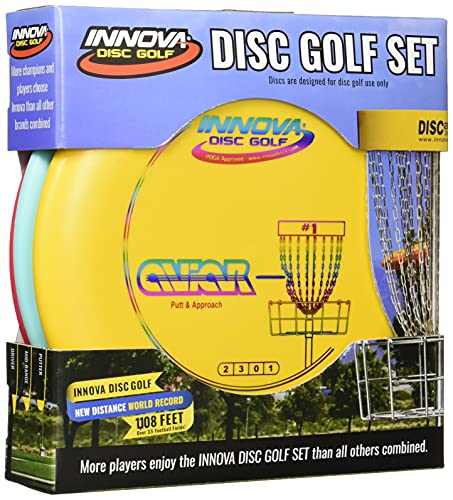
Complete Set: Includes One Driver, One Mid-Range And One Putter

ALL YOU NEED TO START - This disc golf beginner set contains 3 of our most popular from our entire lineup and provides you with a putter, midrange & a fairway driver. Everything you need to head out to the course. Our disc golf disc set includes some of the most widely known best disc golf discs for beginners just starting out, in an easy to throw plastic

Complete Disc Golf Set with Large Backpack for Adults, this set includes 12 pieces disc golf discs (in 2 types pattern): 4 pieces putter, 4 pieces midrange, 4 pieces driver; Also come with disc golf backpack, which could holds 28+ discs.
Wind Affects Throws
Despite the clear skies, failing to account for the wind’s strength and direction can quickly derail your disc golf game.
As a beginner, it’s essential to grasp how wind affects throws, which can drastically alter the flight characteristics of your disc. A headwind, for instance, can lift and slow down your disc, while a tailwind can push it down and speed it up.
Achieving a consistent release becomes even more critical in windy conditions; it’s the key to maintaining control and precision.
Embrace the challenge: study the wind before each throw, choose your disc wisely, and adjust your technique to harness the wind’s influence. This knowledge is a powerful tool in your quest for an unrestricted, successful disc golf experience.
Temperature Impacts Discs
Neglecting the thermometer’s reading before a round can lead you to choose the wrong disc, as temperature dramatically alters disc behavior in flight.
As a disc golfer, you need to understand that heat can make your discs more understable, affecting their flight path with your arm speed and throwing style. Conversely, the cold can stiffen them, making them more overstable.
Here’s a quick guide:
| Temperature | Disc Behavior |
|---|---|
| Hot | More understable |
| Cold | More overstable |
| Extreme Heat | Very understable |
| Extreme Cold | Very overstable |
Adjust your disc choice and throwing technique accordingly. Don’t let the weather dictate your game; instead, harness the knowledge of temperature effects to enhance your freedom on the course.
Rain Changes Grip
In rainy conditions, your disc’s grip can be compromised, leading to less precise throws and a frustrating round.
Don’t overlook the challenge that wet weather presents. When it’s pouring, your usual hold on the disc mightn’t cut it. It’s key to adjust your grip to combat the slipperiness. Opt for a disc with a wider rim that offers more control in these slick situations.
Fine-tune your reach back and follow-through to ensure you maintain contact with the disc for as long as possible before release. This extra care allows for better accuracy despite the damp.
Embrace the elements by preparing to adapt your technique. With the right adjustments, you’ll keep your game strong, even when the weather isn’t on your side.
Neglecting Putting Practice
While you’re eager to master your drives, you shouldn’t overlook putting practice as it’s key to lowering your scores on the course.
Too often, beginners focus intensely on long throws, neglecting the finesse and precision putting demands. But it’s on the green where games are won or lost. A little bit of dedicated time to putting can drastically change your end game.
Rather than simply aiming at the basket, work on developing a consistent routine and stroke. This breeds the kind of confidence that ensures you usually end your rounds with successful putts. Without it, you might end up getting bogeys instead of birdies.
Forgetting to Warm Up
You mightn’t realize it, but skipping your warm-up increases your risk of injury and can negatively impact your performance on the course.
By incorporating a routine that primes your muscles and joints, you’re setting yourself up for more consistent and accurate throws.
Injury Risk Increase
By neglecting a proper warm-up before your round, you’re significantly increasing your risk of sustaining muscle-related injuries.
It’s the number one oversight that can lead to an injury risk increase. Imagine being sidelined, watching others play while you’re stuck recovering. Warming up primes your body for the freedom of movement that disc golf demands.
Here’s what you might face if you skip warming up:
| Injury | Recovery Time | Impact on Game |
|---|---|---|
| Strain | Weeks | No Play |
| Sprain | Days to Weeks | Reduced Play |
| Pull | Weeks | No Play |
| Overuse | Months | Long-term Rest |
Don’t be the 19th player who jumps into the game cold. A dynamic warm-up enhances your flexibility and agility, protecting your freedom to play without the shadow of injury.
Performance Impact
During your game, neglecting to warm up can drastically hamper your performance, from reducing throwing accuracy to diminishing your overall control on the course. Remember that disc golf isn’t just a casual toss in the park—it’s a sport demanding precision and agility.
Overlooking a proper warm-up is one of the beginner mistakes that can have a significant performance impact. Warming up primes your muscles, increases your flexibility, and enhances your throwing power, which is vital for achieving those impressive distances.
Commit to a routine that activates your body and sharpens your focus. This dedication not only elevates your game but also safeguards your freedom to play without the constraints of injury or subpar results.
Misunderstanding Disc Stability
Understanding disc stability is crucial, as it’ll greatly affect your disc’s flight behavior and the accuracy of your shots. In disc golf, stability refers to the disc’s tendency to resist turning over in flight or to fade at the end of its flight.
A common beginner mistake is misunderstanding disc stability, leading to poor disc selection and frustration on the course. Remember, overstable discs tend to fade sharply, while understable discs can turn more. If you continually reach for high-speed, overstable drivers without grasping their true nature, you’re likely to struggle with control.
Overcomplicating Technique
Your quest for more distance in disc golf often leads you to overcomplicate your technique, undermining the very power you’re trying to harness.
Unlike traditional golf, where a club does the work, disc golf relies on a harmony of body mechanics. I’d recommend focusing on engaging your core and lower body, not just your arm strength. This approach generates momentum and a smoother release.
In disc golf remember that simplicity is your ally. Avoid the temptation of high-speed, overstable drivers until your form is ready. Concentrate on specific adjustments, like unfolding your arm from the right position. This won’t just add distance, but also improve consistency, giving you the freedom to play with confidence and ease.
Disregarding Course Etiquette
You mightn’t realize it, but overlooking play order, leaving trash on the fairways, and creating loud distractions can disrupt the flow of the game for everyone.
It’s essential to respect your fellow players by knowing when it’s your turn, keeping the course clean, and maintaining a quiet environment during throws.
Ignoring Play Order
Failing to observe the established play order is not just breaking a fundamental rule of disc golf etiquette, but also potentially disrupting the flow and enjoyment of the game for others. It’s crucial to respect the sequence in which players take their turns. This is usually determined by the scores on the previous hole or by who’s furthest from the basket.
Not only does following the play order keep the round organized, but it also ensures fairness and safety on the course. Remember, disc golf, much like traditional golf, thrives on mutual respect among players.
Littering Fairways
A player’s disregard for the cleanliness of the course, such as leaving trash on the fairways, not only violates disc golf etiquette but also tarnishes the game’s natural setting.
You’re not just playing a sport; you’re sharing an environment that thrives on respect and care. It’s crucial to uphold the integrity of the course for fellow enthusiasts and wildlife alike.
Pack out what you pack in, ensuring that wrappers, bottles, and any other rubbish leave the course with you. Staying mindful of your impact keeps the fairways pristine and the game honorable.
By embracing this aspect of disc golf etiquette, you contribute to a culture that values the freedom of play in a clean, preserved landscape.
Loud Distractions
Maintain the serenity of the course by refraining from loud conversations or noises that can distract players during their throws.
Remember, your freedom on the course comes with the responsibility to respect others’ concentration. Just like in traditional golf, the tranquility of the game is paramount. Keep in mind that even minor distractions can affect a player’s focus and performance.
Embrace being a silent observer – a ‘tree’ in the background – especially when someone is taking their shot. Movement in a thrower’s peripheral vision can be just as disruptive as noise.
Regularly reviewing the PDGA Official Rules will help you grasp the nuances of disc golf etiquette. Your awareness and consideration will ensure a harmonious experience for everyone on the course.
Skipping Fundamental Skills
You’ll find your game suffers when you overlook mastering disc golf etiquette, an essential skill set for any player.
It’s not just about playing; it’s respecting the course and your fellow players, which ultimately enhances everyone’s experience. Patience and focus are key. Without them, your accuracy won’t improve, and those precise throws will remain elusive.
Don’t fall into the trap of thinking sheer arm strength will carry your game. Instead, learn to harness your body’s momentum for more powerful, controlled throws. Understand your discs’ flight characteristics; choose wisely to optimize each shot. Avoid the temptation of high-speed, overstable drivers until your technique is solid.
This disciplined approach will grant you the freedom to play your best disc golf.
Keep at it, and you’ll see progress.
Inconsistent Footwork
While you may not realize it, inconsistent footwork can sabotage your disc golf game by causing unpredictable throws and diminishing your power.
Proper footwork is the foundation of a reliable and forceful throw. It’s about engaging your lower body in a smooth, controlled motion to harness more power and speed. Picture your feet as the drivers of your body’s momentum, leading you to that satisfying snap and release.
By prioritizing consistent footwork, you’ll not only maximize your distance potential but also ensure a more precise release point.
Embrace the discipline of footwork; it’s the key to turning those bogeys into birdies and gaining the freedom to shape your shots exactly how you envision them.
Failing to Track Progress
You mightn’t realize it, but tracking your progress is as crucial as perfecting your throw. By documenting your performance metrics and engaging in reflective journaling, you gain invaluable insights into your game.
This practice not only highlights your strengths and pinpoints areas for improvement but also fuels your motivation as you witness your own development.
Importance of Metrics
Why aren’t you tracking your disc golf metrics when they’re key to pinpointing your game’s strengths and weaknesses? You’re missing out on the power of data. By measuring your throws, you’re equipping yourself with the knowledge to sharpen your skills. Let’s break it down:
| Metric | Purpose |
|---|---|
| Distance | Gauges power & form |
| Accuracy | Assesses precision & control |
| Consistency | Tracks reliability of play |
Analyzing these metrics empowers you to set realistic goals and celebrate improvements, no matter how small. Don’t underestimate the value in knowing precisely where you stand. Start tracking and watch your freedom on the course soar as you master the art of disc golf, one throw at a time. Keep it technical; keep it targeted. You’ve got this!
Benefits of Journaling
Keeping a journal of your disc golf outings can dramatically improve your game by providing clear insights into your progress and areas needing attention.
By meticulously recording each round, you’ll capture invaluable data that pinpoints your strengths and weaknesses. This isn’t about restricting your freedom on the course; it’s about giving you the tools to break free from plateaus and excel.
With a journal, you’re not just tossing discs; you’re strategically building your skills. You’ll begin to notice patterns in your play, understand the impact of various conditions, and set informed goals.
Don’t let your hard-earned milestones slip by unnoticed. Embrace journaling to celebrate your victories, learn from missteps, and steer your disc golf journey toward continuous improvement.
Overusing Power Throws
Amid your efforts to master disc golf, it’s vital to recognize that overusing power throws can compromise your precision and control on the course.
Harnessing smooth movements and focusing on form, rather than sheer distance, will significantly enhance your accuracy and gameplay. Engage your core and lower body in your throws to improve momentum, making your arms less prone to fatigue.
Selecting the right disc is crucial; lightweight discs and avoiding high-speed, overstable drivers can curb the temptation to overdo power throws. Always seek advice from seasoned players to refine your technique. Remember, restraint can often lead to freedom on the course, as it opens up a variety of strategic play options.
| Power Throws | Technique Enhancement | Strategic Play |
|---|---|---|
| Less Control | Smooth Movements | Disc Selection |
| Arm Fatigue | Engage Core | Seek Guidance |
| Decreased Accuracy | Lower Body Involvement | Play Options |
| Overreliance | Form Focus | Restraint Benefits |
Limited Shot Variety
How can you navigate the course effectively if your shot selection lacks variety?
Disc golf courses present diverse challenges, from winding fairways to unpredictable winds. Relying on a singular throw limits your adaptability, potentially costing you strokes.
It’s essential to develop a range of shots – hyzers, anhyzers, forehands, backhands, and rollers. Each has its unique flight path and use in circumventing obstacles, managing elevation changes, and tackling various wind conditions.
Expand your repertoire to not only improve your score but also to revel in the freedom of choosing your path on the course. Embrace the practice; it’s the gateway to crafting your signature style and elevating your disc golf game.
Poor Disc Care
While mastering a variety of shots is crucial, neglecting the care of your discs can seriously hamper their performance and your progress in the game. Dirt and grime on your discs alter their aerodynamics, so it’s essential to clean them after each round.
Store your discs flat and out of extreme temperatures to prevent warping and maintain their intended flight characteristics. Regularly inspect them for cracks or damage, as these flaws can lead to unpredictable flights or even injuries during play.
Don’t let wet play conditions be the downfall of your discs either. Always dry them off to thwart mold or mildew, which can ruin grip and flight.
Proper disc care is an investment in your game’s consistency and your freedom on the course.
Not Playing Different Courses
Beyond caring for your discs, you’ll stunt your growth in the game if you don’t venture out to different courses. Sticking to one course feels comfortable, but it’s the variety that truly sharpens your skills.
Each new course offers a unique blend of terrains, distances, and obstacles, challenging you to adapt and strategize differently. This exposure is crucial; it builds your ability to handle the unexpected and understand the nuances of disc golf.
Embrace the freedom to explore—each course is a new adventure, a chance to refine your throws and decision-making. Playing varied courses enriches your experience and transforms you into a more versatile player.
Don’t limit yourself; growth lies in diversity. Spread your wings and play!
Avoiding Community Engagement
Community involvement is essential; by not engaging with fellow disc golfers, you’re missing out on valuable insights and camaraderie. The disc golf community is a rich resource for learning and growth. Here’s how involvement can enhance your experience:
| Benefits of Engagement | How To Participate | Impact on Your Game |
|---|---|---|
| Improved Etiquette | Observe & Adapt | Fewer Mistakes |
| Rule Knowledge | Study & Discuss | Better Compliance |
| Skill Development | Seek Feedback | Enhanced Performance |
| Networking | Join Clubs | More Opportunities |
| Enjoyment | Share Experiences | Increased Fun |
How Can Sharing Discs Help Beginners Avoid Common Mistakes in Disc Golf?
Sharing discs within the community spirit in disc golf can help beginners avoid common mistakes. Trying different discs allows players to find what works best for them, while learning from others’ experiences. By sharing and exchanging discs, beginners can gain valuable insight and improve their game more quickly.
Conclusion
You’ve tackled the common slip-ups, from misjudging discs to skipping warm-ups. Remember, perfecting your game is a journey—embrace every weather twist, cherish your putter, and diversify your shots.
Care for your gear, explore new courses, and join the community. Keep honing your skills, seek feedback, and stay patient.
Your disc golf prowess is on the rise. Now, go make those drives count and watch your game soar!

As the first disc featuring SHELL dual-ring technology, this driver delivers enhanced rotational stability for superior wind resistance and effortless distance. Its optimized rim-core balance reduces power requirements while maintaining consistent flight patterns.

PRACTICE BACKHAND OR FOREHAND: QOGIR disc resistance trainer is an excellent resistance training system for improving your disc golf arm speed. Great for enhancing your muscles and your muscle memory, this works both forehand and backhand driving techniques.Really help you build in the muscle memory to stop rounding.

Crystal Series – Stunning & PDGA-Approved | Premium crystal-clear discs with jewel-like shine that perform as good as they look—PDGA-certified for tournament play while turning heads on the course. Perfect blend of style and substance.