
You’re stepping onto the disc golf course, eager to refine your game. You’ve got power and precision, but to truly excel, you must master various throws.
Whether you’re working on your backhand, forehand flick, or the nuanced overhand shots, each technique demands attention.
From the essential rollers to the strategic hyzer and anhyzer throws, this guide sharpens your skills for that perfect line to the basket.
Let’s unlock your full potential and let those discs fly free.
Mastering the Quintessential Backhand
Within the realm of disc golf, you’ll find the backhand throw indispensable for its power and distance capabilities. Mastering the backhand grip is your first step; wrap your fingers tightly along the disc’s underside and rest your thumb on top for control.
Power generation is crucial, hinging on a blend of lower body strength and upper body torque. As you draw your arm back, focus on a smooth, rapid motion, ensuring your release timing is synchronized with your body’s forward momentum.
The release point dictates the disc’s flight path, affecting its stability and curvature. Disc selection is equally vital; choose a disc that complements your skill level and the intended trajectory.
Mastering the Forehand Flick
While you’re getting the hang of the backhand throw, don’t overlook the forehand flick, a technique that’ll add versatility to your game by allowing for different angles and approaches on the course. The forehand grip is crucial—place your index and middle fingers under the disc and your thumb on top. For a powerful throw, focus on your wrist snap and power transfer. Ensure your release point is consistent for accuracy.
Incorporate these practice drills to refine your forehand flick:
| Drill | Focus Area | Description |
|---|---|---|
| 1 | Forehand Grip | Work on finger placement and disc stability. |
| 2 | Wrist Snap | Practice the flicking motion without releasing the disc. |
| 3 | Power Transfer | Engage your hips and shoulders to maximize power. |
| 4 | Release Point | Throw at a target to improve precision. |
Mastering the forehand flick gives you the freedom to navigate any course with confidence.

CORRECTS HAND POSITIONING ON EVERY SWING: Molded guide attaches to your club and places your fingers, thumbs, and palms in the correct neutral grip position; helps eliminate common faults like a strong grip, weak grip, or open right hand that lead to slicing and hooking

Training grip provides the correct hand position for the right golf grip
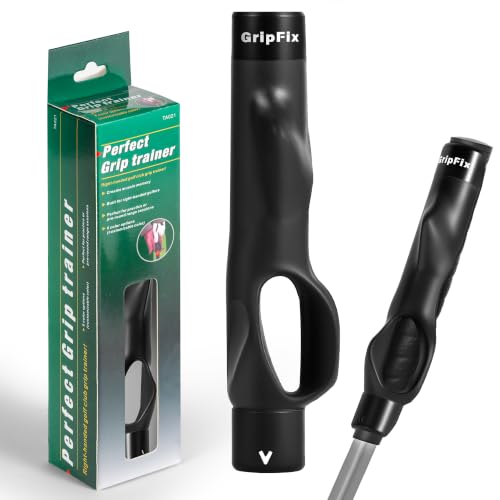
STOP SLICING & HOOKING INSTANTLY — Most inconsistent shots start with a bad grip. GripFix's precision-molded guides lock your left and right hands into the correct neutral position on every swing. Build muscle memory that eliminates weak grips, overlapping fingers, and palm misalignment — the fastest way to straighten your drives and gain shot confidence without expensive lessons.
Unleash the Versatile Tomahawk
Although it’s less common than the backhand or forehand, you’ll find the overhand tomahawk throw invaluable for maneuvering through obstacles and tight windows on the disc golf course. Mastering the tomahawk grip is crucial; you’ll hold the disc similar to a forehand but with your thumb pressing firmly on the disc’s underside.
Understanding flight physics is essential—your disc will flip and turn over mid-air, dependent on the release angle you choose.
When executing the throw, factor in wind considerations; headwinds and tailwinds can drastically alter your disc’s path. Generate power by channeling strength from your core and shoulders, ensuring a swift, whip-like motion.
The more precise your release angle, the more control you’ll have over the disc’s flight, granting you the freedom to navigate the most complex courses.
Harness the Power of the Thumber Toss
Transitioning from the tomahawk, you’ll find the thumber toss offers a unique blend of control and accuracy for overhead throws.
Mastering thumber mechanics is crucial; it involves tucking the disc between your thumb and forefinger, allowing for grip variations that influence flight dynamics. You must be mindful of weather effects, as wind can drastically alter the disc’s path.
Release timing is vital; a precise moment optimizes the disc’s trajectory for targeted landing zones.
| Aspect | Detail | Impact on Throw |
|---|---|---|
| Grip Variations | Thumb position and pressure | Changes flight stability |
| Release Timing | Synchronization with stride | Affects angle and distance |
| Weather Effects | Wind direction and speed | Alters disc flight path |
| Flight Dynamics | Spin rate and axis tilt | Dictates flight pattern |
Embrace your freedom to experiment with these variables to refine your thumber toss, enhancing your disc golf experience.
Liberate Your Game with the Roller Shot
After honing your thumber toss, you’ll want to explore the roller shot, an advanced technique that can navigate tight fairways or bypass obstacles with its ground-traveling path. Mastering roller physics is vital; you’ll need to understand how to angle your disc and apply force to ensure it lands on its edge and continues to roll.
Ground play is equally critical—choose a disc that complements the terrain, opting for one that can handle the unpredictability of land interaction.
Disc selection is paramount; a more understable disc typically makes for an easier roller. Moreover, wind considerations are essential; a headwind can lift and carry the disc, while a tailwind can push it down prematurely.
Employ the roller shot strategically for effective obstacle navigation, liberating yourself from traditional aerial routes.
Shape Your Shots with the Hyzer Throw
In addition to mastering roller shots, you’ll find the hyzer throw indispensable for curving around obstacles on the course with its distinctive flight pattern. Understanding hyzer benefits starts with recognizing its ability to navigate tight fairways and counteract crosswinds.
To execute a hyzer, you’ll need to consider wind considerations, selecting a disc with a stable to overstable flight rating for reliability. Your grip is crucial; a power grip ensures a firm hold, allowing for a controlled release.
When it comes to the release point, aim to release the disc with the edge closest to you tilted downward—it’s this angle that defines the hyzer throw. With practice, this throw will become a versatile tool in your disc golf arsenal, offering freedom to shape your shots under various course conditions.
Complement Your Game with the Anhyzer Angle
To complement your hyzer technique, you’ll need to master the anhyzer throw, which requires tilting the disc’s edge upwards upon release. This method leverages anhyzer benefits, allowing you to navigate obstacles by curving the disc’s flight to the right (for right-hand backhand throws) or to the left (for left-hand backhand throws).
When assessing wind considerations, factor in how a headwind can amplify the anhyzer’s curve, while a tailwind might lessen it.
Fine-tune your release mechanics, ensuring a consistent angle and wrist snap. Disc selection is integral; understable discs typically enhance the anhyzer’s effect.
Lastly, modulate your power control; too much force can turn the throw into a roller, whereas too little won’t maintain the anhyzer angle long enough.
Putting: The Final Approach
Once you’ve mastered the anhyzer, you’ll find putting is the crucial next step that can make or break your score. It’s essential to refine your putting mechanics to ensure consistency and accuracy. Focus on developing stance stability; a solid base enhances your balance and control, allowing for a smooth follow-through.
Experiment with grip variations to find what gives you the most confidence and precision during your putt. Mental focus is paramount; block out distractions and visualize the disc’s path into the basket. Be aware of the weather impact—adjust your force and angle to combat wind resistance or other elements.

Flick - Distance Driver: Speed 12 | Glide 3 | Turn 1 | Fade 5 | Stability 2.5. Please note: Disc colors and stamp will vary, weight range 160-175.1g. For extreme wind conditions and maximum overstability grab meat hook flying Flick! Ideal for powerful forehand shots or precision hyzer flex approaches.
Flick - Distance Driver: Speed 12 | Glide 3 | Turn 1 | Fade 5 | Stability 2.5. Please note: Disc colors and stamp will vary, weight range 160-175.1g. For extreme wind conditions and maximum overstability grab meat hook flying Flick! Ideal for powerful forehand shots or precision hyzer flex approaches.
